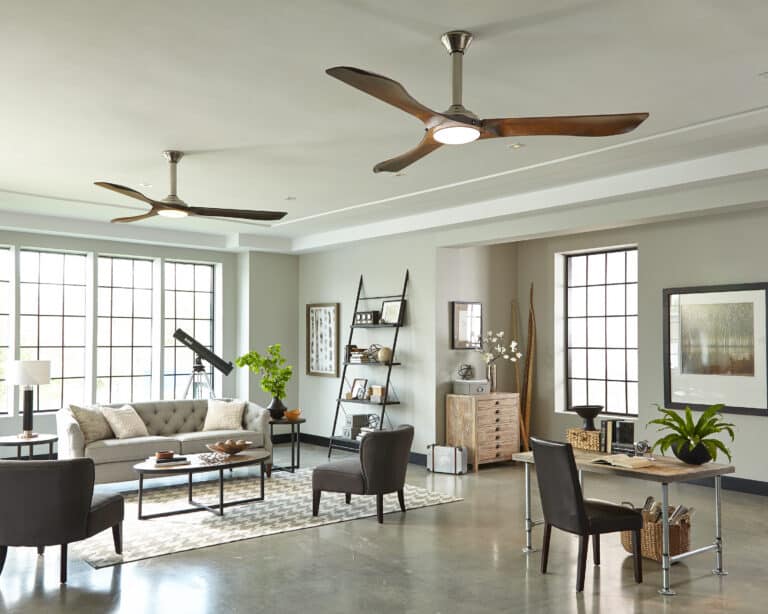
A ceiling fan doesn’t have to be an afterthought or an eyesore. When chosen thoughtfully, a fan can become both a practical tool for comfort and a sculptural presence within the space.

Key Benefits of Understanding CFM
- CFM (cubic feet per minute) is the standard measure of how much air a ceiling fan moves, making it one of the most reliable ways to compare fan performance
- Matching CFM to your room size ensures effective air circulation without over- or under-powering the space
- Higher airflow efficiency (CFM per watt) translates directly to lower energy costs over the life of the fan
- Understanding what drives CFM, from motor type to blade pitch, helps you look past marketing claims and choose based on real performance
- Pairing the right CFM rating with thoughtful design means a fan that contributes to both the comfort and the visual composition of the room
But while design matters, performance is just as important. One of the key indicators of a ceiling fan’s performance is airflow, or how effectively it moves air throughout a room. This performance is measured using CFM, or cubic feet per minute, a standard metric that describes how much air a ceiling fan circulates each minute.
Understanding ceiling fan airflow and CFM ratings can help you select a fan that not only complements your interior design but also improves comfort and efficiency throughout the home.
What Is CFM in a Ceiling Fan?
CFM, or cubic feet per minute, measures the volume of air a ceiling fan moves at its highest speed. A higher CFM rating indicates stronger air circulation, which can improve comfort and help distribute heated or cooled air more evenly throughout a space.
It is worth noting that CFM is measured under controlled laboratory conditions at the fan’s maximum speed setting, following testing protocols established by the Department of Energy and Energy Star. This standardized approach ensures that the CFM number listed on a product page reflects a consistent, comparable measurement across brands and models.
Airflow is influenced by several factors, including blade span, blade pitch, motor performance, and overall fan design. When comparing ceiling fans, airflow is one of the most reliable indicators of how effectively the fan will circulate air.
Why Ceiling Fan Airflow Matters
Airflow plays a significant role in how a room feels. Even subtle air movement can make a space more comfortable, particularly in rooms where people gather for extended periods of time.
While ceiling fans don’t actually lower the temperature of a room, the movement of air creates a wind-chill effect that makes the space feel cooler. In warm months, this added circulation improves comfort while reducing reliance on air conditioning.
During warmer seasons, set the fan to rotate counterclockwise. This pushes air downward in a column, creating a direct breeze that cools the skin. In cooler months, reverse the direction to clockwise and run the fan on a low setting. This gentle updraft draws cool air upward and pushes warm air, which naturally collects near the ceiling, back down along the walls and into the living space. For a deeper look at seasonal settings, see this guide on ceiling fan direction.
A fan that moves air efficiently can reduce the need for constant HVAC use while maintaining a pleasant environment year-round.
What Affects a Ceiling Fan's CFM?
Several design and engineering factors determine how much air a ceiling fan can move. Understanding them makes it easier to read spec sheets with a designer’s eye rather than simply chasing the highest number.
Motor type. DC motors are quieter, more compact, and significantly more energy-efficient than traditional AC motors. They also offer a wider range of speed settings, giving you finer control over airflow without sacrificing performance.
Blade pitch. Blade pitch refers to the angle of the blades relative to horizontal. A steeper pitch moves more air per rotation, which is why pitch is one of the most important factors in CFM performance. Most high-performance fans feature a blade pitch between 12 and 15 degrees.
Blade span and shape. Longer blades cover a wider area, but shape matters just as much as size. Aerodynamically contoured blade profiles push air more efficiently than flat, paddle-style blades, translating motor power into effective circulation with less resistance.
Number of blades. A common assumption is that more blades produce more airflow. In practice, this is not the case. Blade pitch, motor strength, and blade shape have a far greater influence on CFM than blade count. A well-engineered three-blade fan can outperform a five-blade model with a shallow pitch and weaker motor.
What Is Airflow Efficiency in a Ceiling Fan?

In addition to CFM, another useful metric when comparing ceiling fans is airflow efficiency. This measurement describes how much air a fan moves relative to the amount of electricity it consumes.
Airflow efficiency is calculated by dividing a fan’s CFM rating by the watts used at its highest speed. The result indicates how effectively the fan converts energy into air movement. Fans with higher efficiency ratings deliver strong airflow while using less power. As a benchmark, a rating of 75 CFM per watt or higher is considered efficient by current standards.
Energy Star certification sets specific airflow thresholds that provide a useful reference point: certified fans must deliver a minimum of 1,250 CFM on low speed, 5,000 CFM on medium speed, and 7,500 CFM on high speed. These benchmarks are a reliable starting point when evaluating whether a fan will perform well across all settings, not just at its peak.
What Is a Good CFM for a Ceiling Fan?
The ideal airflow rating depends largely on the size of the room and the fan’s intended purpose. Larger spaces require stronger airflow in order to circulate air effectively.
As a general guideline:
| Room Size | Square Footage | Recommended CFM Range | Suggested Fan Size |
|---|---|---|---|
| Small rooms | Up to 100 sq ft | 2,000 to 3,000 CFM | 36″ to 42″ |
| Medium rooms | 100 to 300 sq ft | 3,000 to 5,000 CFM | 44″ to 52″ |
| Large rooms or open spaces | 300 to 500+ sq ft | 5,000 to 7,000+ CFM | 54″ to 72″+ |
| Outdoor spaces | Patios, covered porches | 5,000 to 7,000+ CFM | 54″ to 72″+ (damp/wet rated) |
For rooms with ceilings above 10 feet, target the upper end of the CFM range for your square footage. Higher ceilings increase the volume of air in the space, which means the fan needs to work harder to circulate effectively. A downrod can also help position the fan closer to the occupied zone, improving perceived airflow.
While higher airflow is often beneficial, the goal is balance. A well-designed fan should move air efficiently while maintaining quiet operation and proportional scale within the room.
Designers often select fans that combine strong airflow, refined engineering, and thoughtful design, ensuring the fixture supports both comfort and the visual composition of the space. The Lumens Fan Finder can help match the right fan to your room dimensions and performance needs. For large rooms and open floor plans, look for models specifically engineered for high-volume air movement.
Choosing a Ceiling Fan That Balances Design and Performance
Selecting the right ceiling fan requires balancing several considerations. Beyond aesthetics, it’s important to evaluate how well the fan will perform in the room where it will be installed.
When comparing ceiling fans, consider:
- The size of the room
- The fan’s airflow rating (CFM)
- Motor type (DC vs. AC)
- Motor efficiency and energy use
- Blade design and overall scale
Modern ceiling fans are designed to complement contemporary interiors while delivering strong airflow and energy efficiency. Many models incorporate advanced motor technology, integrated LED lighting, and refined materials that allow the fan to function as both a practical appliance and an architectural detail.
When selected thoughtfully, a ceiling fan becomes more than a source of air circulation. It contributes to the comfort, rhythm, and visual balance of the room.
Ceiling Fan CFM FAQs
What Is a Good CFM for a Bedroom Ceiling Fan?
For most bedrooms, a fan delivering 3,000 to 5,000 CFM provides comfortable air circulation without excessive noise. The right balance depends on room size and personal preference for airflow intensity; a master suite will need more than a guest bedroom.
Expert Tip: Prioritize a DC motor fan with multiple speed settings. Lower speeds are quieter for sleeping, and you will still have higher settings available when you need stronger circulation during warmer months.
Does a Bigger Ceiling Fan Always Have More CFM?
Not necessarily. While a larger blade span covers more area, CFM is determined by the combination of blade pitch, motor power, and blade shape. A compact fan with a steep blade pitch and a high-performance DC motor can move more air than a larger fan with flat blades and a less capable motor.
Expert Tip: Compare CFM ratings directly rather than relying on blade span as a proxy for performance. Spec sheets tell the real story.
How Do I Check a Ceiling Fan’s CFM Before Buying?
CFM is typically listed on the product specification sheet or product page. Look for the airflow rating at the fan’s highest speed setting. If a manufacturer does not publish a CFM rating, that is worth noting; reputable brands test and disclose this information.
Expert Tip: Look beyond the peak CFM number. Check airflow efficiency (CFM per watt) and, where available, CFM at medium and low speeds. A fan you run on medium every day matters more than one that impresses only at its highest setting.
Can a Ceiling Fan Replace Air Conditioning?
A ceiling fan alone cannot lower a room’s temperature, but it can significantly reduce the need for air conditioning. The wind-chill effect created by a fan makes a room feel several degrees cooler, which allows you to raise the thermostat setting while maintaining the same level of comfort.
Expert Tip: Pair a ceiling fan with your AC system rather than choosing one over the other. Running a fan while raising the thermostat by even two to three degrees can meaningfully reduce energy costs over the course of a season.
What Is a Good CFM Per Watt for an Energy-Efficient Ceiling Fan?
A rating of 75 CFM per watt or higher is a strong indicator of efficiency. Fans that meet Energy Star certification thresholds are a reliable choice, as they must demonstrate minimum airflow across all speed settings while maintaining low energy consumption.
Expert Tip: DC motor fans consistently outperform AC motor models in CFM-per-watt ratings. If energy efficiency is a priority, a DC motor is the single most impactful feature to look for.
Shop the latest modern lighting, furniture, and decor collections.