What Are Lumens? Why Lumens Matter More Than Watts
When shopping for light bulbs, brightness is key. In the past, most of us relied on watts to judge how bright a bulb would be. But with the rise of energy-efficient lighting like LED bulbs, watts now measure only energy use—not light output. Enter lumens: the new gold standard for measuring brightness.
Definition:
A lumen is the unit of measurement for the total amount of visible light emitted by a source. Simply put:
More lumens = brighter light.
Lumens vs. Watts: What’s the Difference?
- Lumens measure the actual brightness a bulb delivers.
- Watts measure the energy consumed to produce that light.
Thanks to modern energy-efficient lighting, you can now enjoy the same brightness with far less energy use. For example, an LED bulb can produce the same amount of light as an old incandescent using a fraction of the power.
Lumens to Watts Conversion Chart
Confused about which bulb to buy? Use this handy chart to match the brightness you want with the energy-saving bulbs available today:
|
Incandescent Wattage |
LED Equivalent Wattage |
Lumens (Brightness) |
|
100W |
Up to 22W |
1600 lumens |
|
75W |
Up to 20W |
1100 lumens |
|
60W |
Up to 12W |
800 lumens |
|
40W |
Up to 9W |
450 lumens |
Tip:
A standard 60W incandescent bulb = 800 lumens.
A 40W bulb = 450 lumens.
Use these numbers to compare different options for your next ceiling light or table lamp.
How to Read a Light Bulb Label
Modern light bulbs now feature a “Lighting Facts” label, making it easier than ever to find the right fit for your needs. Here’s what to look for:
- Brightness: Shown in lumens. (e.g., 1100 lumens ≈ 75W incandescent)
- Estimated Yearly Cost: Based on typical usage.
- Bulb Life: Expected lifespan, usually in years.
- Light Appearance: Color temperature, from warm (2700K) to cool daylight (5000K+).
- Energy Used: Actual wattage consumed.
Want to learn more about color temperature? Visit our guide on choosing the right light color for your space.
How to Choose the Best LED Bulb
Ready to upgrade? Here’s what to consider:
Look for the ENERGY STAR® Label
Choose ENERGY STAR-certified LED bulbs for guaranteed quality, efficiency, and long life.
Check the Color Rendering Index (CRI)
A high CRI (80 or above) means colors appear more natural under the light. For spaces like bathrooms or kitchens, aim for a CRI of 90+.
Select the Right Color Temperature
- Warm White (2700K–3000K): Cozy, inviting—perfect for living rooms and bedrooms.
- Neutral White (3500K–4100K): Great for kitchens and workspaces.
- Daylight (5000K+): Crisp, energizing—ideal for task lighting and garages.
Focus on Lumens, Not Watts
Replace old bulbs by matching lumens, not watts.
- 75W incandescent → 1100 lumen LED
- 40W incandescent → 450 lumen LED
Explore our full range of pendant lighting and wall lights to find the perfect match for your next upgrade.
Why Energy-Efficient Lighting Is the New Standard
Incandescent bulbs waste up to 90% of their energy as heat.
Thanks to updated federal energy regulations, inefficient bulbs are being phased out across the U.S., including a complete ban on incandescent bulbs from 2023 onward. This shift is projected to save American households an estimated $3 billion each year.
Modern LEDs come in a variety of shapes, sizes, and colors—including styles that mimic the classic warmth of incandescent lighting.
Key Benefits of LED Bulbs
- Major Energy Savings: Use up to 75% less energy than incandescent bulbs.
- Long Lifespan: Lasts 25,000+ hours—less time replacing, more time enjoying.
- Dimmable Options: Many LEDs are compatible with dimmers.
- Better for the Planet: Reduced carbon footprint and energy waste.
- Versatile Designs: Find options for outdoor lighting, recessed lighting, decorative lighting, and more.
Take the Next Step: Shop Smarter, Brighter Lighting
Ready to update your lighting for better efficiency, brighter spaces, and lower energy bills?
Explore our full selection of LED lighting and find the perfect bulbs for every room.
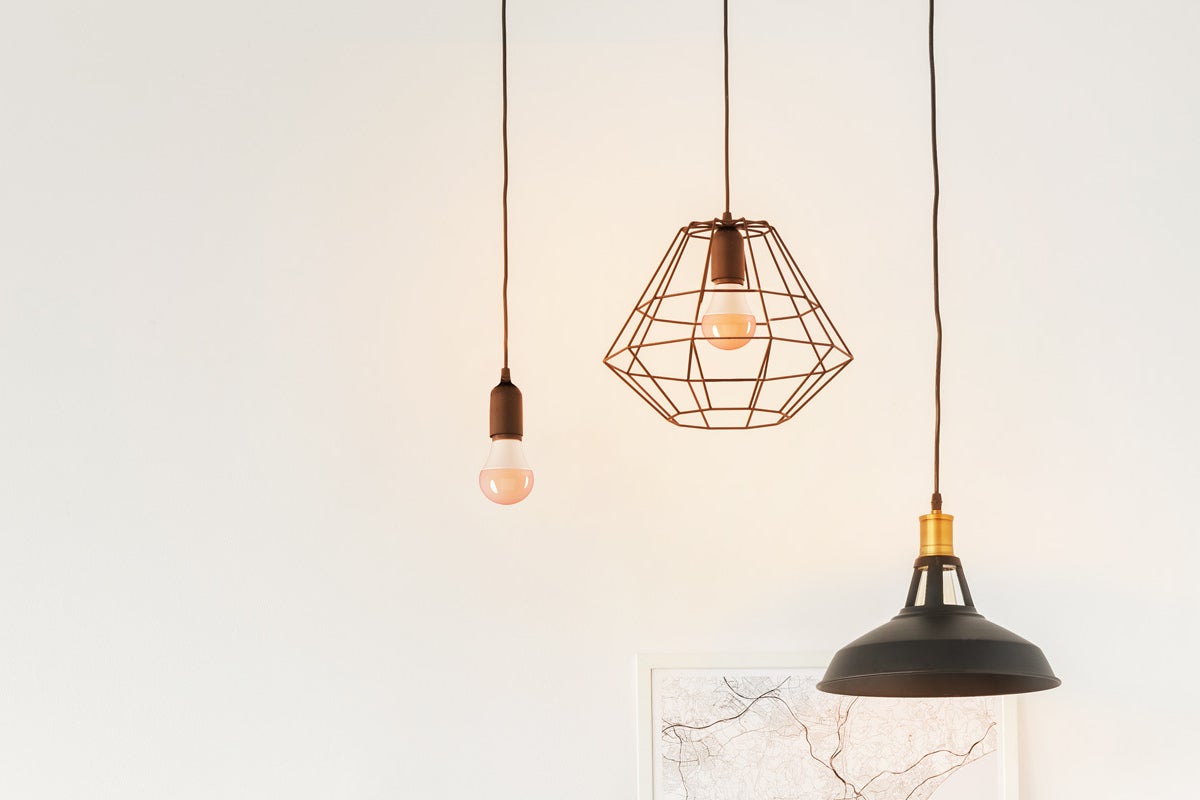
Incandescent bulbs have lit the country for more than a century. Although Thomas Edison is usually considered the father of the light bulb, at least 20 other inventors were working throughout the 1800s to produce what we know today as the first light bulb.
Early History
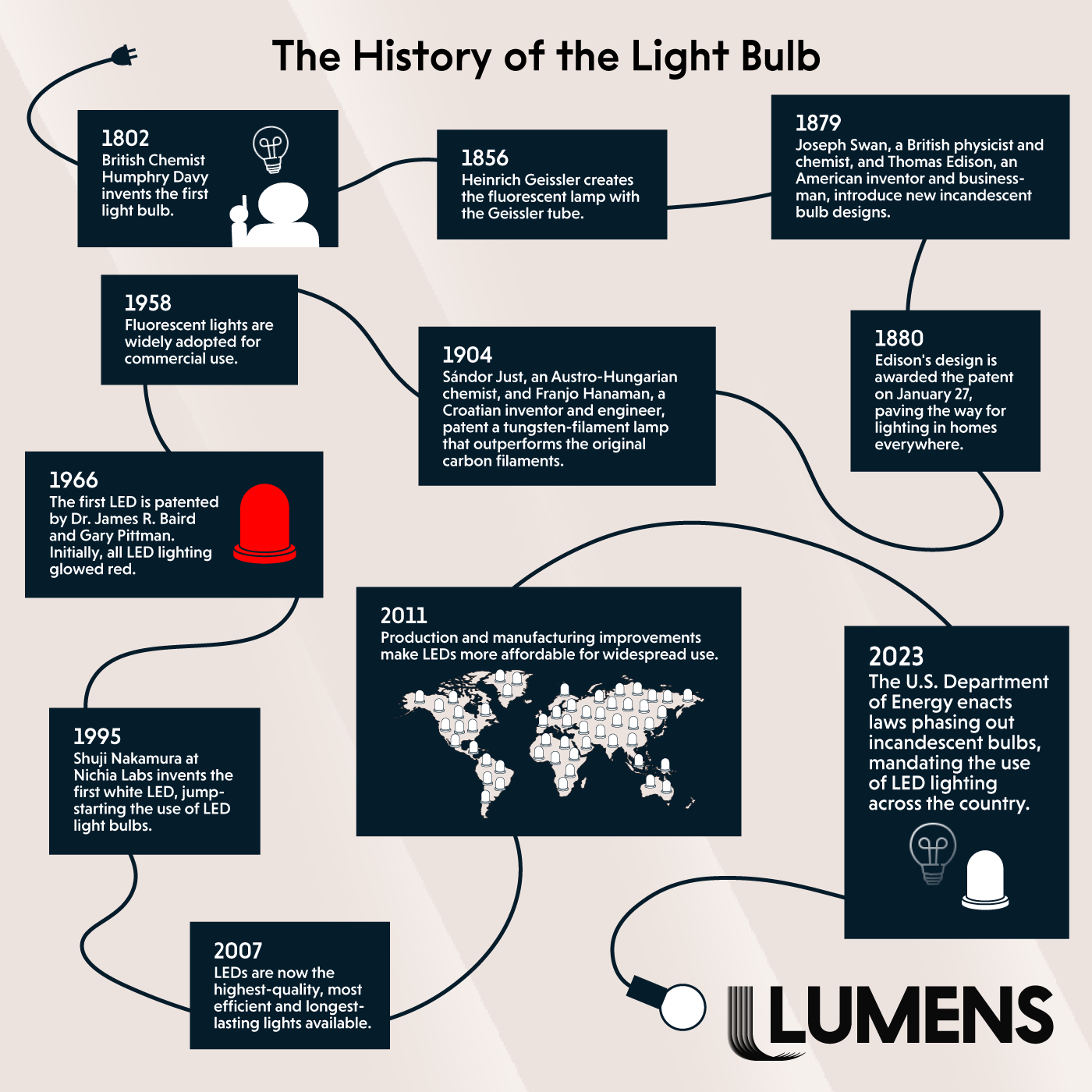
The first demonstration of incandescence is credited to Ebenezer Kinnersley. An English scientist and inventor, he wrote to Benjamin Franklin in 1761 that he had heated a metal wire to the point of it glowing red hot. In 1802, Humphry Davy, a British chemist, connected a battery he made to a thin strip of platinum, causing the metal to glow, although the glow was too bright and too short-lived to be practical.
Over the next seven decades, various experimenters demonstrated the possibility of electric light with platinum or iridium wires, or carbon rods, although none were successful for large-scale commercial purposes. Early bulbs had a short lifespans, required high electric currents or were held back by the high cost of platinum.
The Incandescent Bulb
The incandescent bulb as we know it today has its origins in the works of two men: Joseph Swan, a British physicist and chemist, and Thomas Edison, the American inventor and businessman. In 1850, Swan worked with carbonized paper filaments in an evacuated bulb, and by 1860 was able to demonstrate the invention. Swan used a pump to evacuate the bulb, removing air from the enclosure otherwise the air would rapidly oxidize the filament, ruining it. His invention worked, although the lack of an adequate vacuum to evacuate the bulb and a lack of supply of electricity made it an inefficient source of light. Reworking his invention, in 1879 Swan demonstrated the use of a carbon rod from an arc lamp rather than a slim filament. This allowed the bulb to last 40 hours, and through further refinement and experimentation, Swan’s residence became the first home to be lit by lightbulbs.
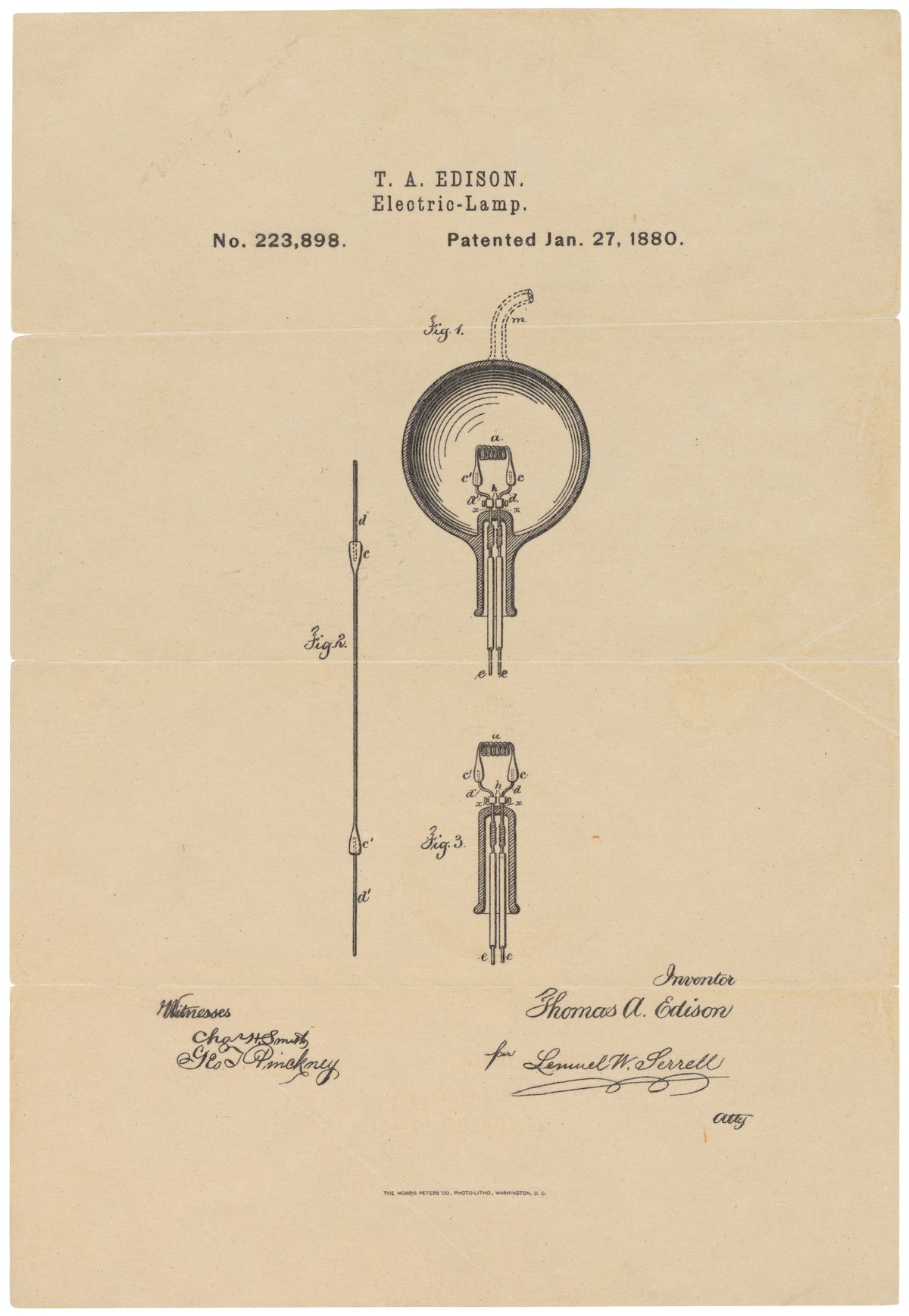
In the late 1870s, Thomas Edison began experimenting with platinum and carbon filaments, producing a bulb in 1879 that lasted 13.5 hours. He and his team filed for U.S. patent 223,898 on November 4, 1879. It was granted on January 27, 1880, although several months later, his team discovered that a carbonized bamboo filament could last over 1,200 hours. With funding from J.P. Morgan, Spencer Trask and the Vanderbilt family, Edison formed the Edison Electric Light Company. His first client was Henry Villard, president of the Oregon Railroad and Navigation Company, who desired his ship the Columbia to have Edison’s electric light installed aboard.
Through the 1880s, Edison faced court battles over his patents. In 1883, the patent office ruled Edison’s patent invalid as it was based on the works of William E. Sawyer, an electrical engineer who worked with Albon Man, a lawyer and scientist, to invent an electric lamp and electric lighting system. In 1889, a judge reversed the patent office’s decision and, wishing to avoid another legal battle, Edison formed a joint company with Joseph Swan: Edison & Swan United Electric Light Company.
The Tungsten Filament
Although in widespread use by the 1890s, the use of a carbon filament would ultimately prove inefficient. In 1904, Sándor Just, an Austro-Hungarian chemist and Franjo Hanaman, a Croatian inventor and engineer, patented a tungsten filament lamp that lasted longer and emitted brighter light than carbon filaments. By 1911, with developments from William D. Coolidge, an American physicist and engineer, General Electric sold incandescent bulbs with tungsten wire. By 1914, 88.5 million lamps were in use, with only 15% of them having carbon filaments. Improvements in efficiency and production were made through the early and mid-1900s, leading to the incandescent bulb we know today.
The Fluorescent Lamp
Alongside the development of the incandescent lamp was the fluorescent bulb. Credited to Heinrich Geissler in 1856, the fluorescent lamp saw its beginnings with the Geissler tube, a partially evacuated tube with electrodes at either end. When different chemicals were placed inside, the tube would glow in various colors. The Geissler tube was mainly used for entertainment purposes. Edison patented a fluorescent lamp in 1907 but saw no reason to develop it in favor of his incandescent bulb. In 1895, Daniel McFarlan Moore, a former employee of Edison, created lamps that used carbon dioxide or nitrogen to emit white or pink light, respectively. Although his invention was largely expensive, complicated and required high voltages, it was more efficient than incandescent lamps and more closely produced the look of natural daylight.
The widespread adoption of fluorescent lamps has its origin in the invention of neon lamps. Georges Claude, a French engineer and inventor, experimented with the Geissler tube to produce the first neon lamps. Primarily used for advertising, neon lamps are gas-based lamps filled with neon, argon, mercury and other gases to produce different colors. The fluorescent coating within the tube converts the inert gas and UV light into visible light.
Arthur Compton, a physicist and General Electric consultant, had successful experiments with fluorescent lighting in 1934. Based on Compton’s report, GE built a prototype fluorescent lamp with a team led by George E. Inman. Wishing not to compete with its own incandescent bulbs, GE shelved the fluorescent lamp until factories running 24 hours a day during World War II required more economical lighting.
Light-Emitting Diodes (LEDs)
The most recent incarnation of the light bulb comes in the form of the LED. A light-emitting diode is a semiconductor that emits light when a current flows through it. This current is produced by electrons and electron holes (a lack of an electron) interacting. To keep it simple, electrons orbit around atoms at various levels. When an electron moves from a higher level to a lower level (“filling” the hole), the excess energy is shed and converted into a photon, which creates visible light.
The LED has its origins in 1927 with Russian inventor Oleg Losev, although commercial development and applications would not start until the late 1960s by Hewlett-Packard and Monsanto. The LED as we know it today is considered a “white LED” and emits visible white light through the combination of red, blue and green light. Green LED light, not on the visible spectrum, was created in 1958 by Egon Loebner and Rubin Braunstein. The red LED was developed by Nick Holonyak and was the first on the visible spectrum. Red LEDs were used by Hewlett Packard for indicator lights such as on scientific calculators, as the light was not bright enough to illuminate an area. Widespread usage and adoption of LEDs stalled until the early 1990s when the high-brightness blue LED was created by Shuji Nakamura in 1995.
LEDs are the most efficient form of light bulbs, with some emitting up to 150 lumens per watt (lm/W). To compare, an incandescent bulb produces just 16 lm/W and fluorescent bulbs produce 60 lm/W. With new rules from the Energy Department under President Biden in full effect in August 2023, LEDs are the efficient choice of the future and, for the foreseeable future, are here to stay.
Visit The Lumens Guide to LED