The formula behind dining chairs hasn’t changed since the ancient Egyptians invented them to elevate nobles during meals over 4,000 years ago. Though no longer reserved for the elite, modern dining chairs serve the same purpose, fusing functionality and style at tables of every shape and size.
Millennia of tinkering—coupled with the Renaissance, Industrial Revolution, and invention of plastic—have left us with an abundance of dining chair options from luxe upholstered seats with curving armrests to simple wooden chairs and high stools in every design aesthetic.
Whether you’re redesigning a formal dining room or looking to add a fresh element to a cozy breakfast nook, these iconic dining chairs offer style and support in equal measure–improving every meal and midnight snack.
Standard Dining Chair by Jean Prouvé for Vitra
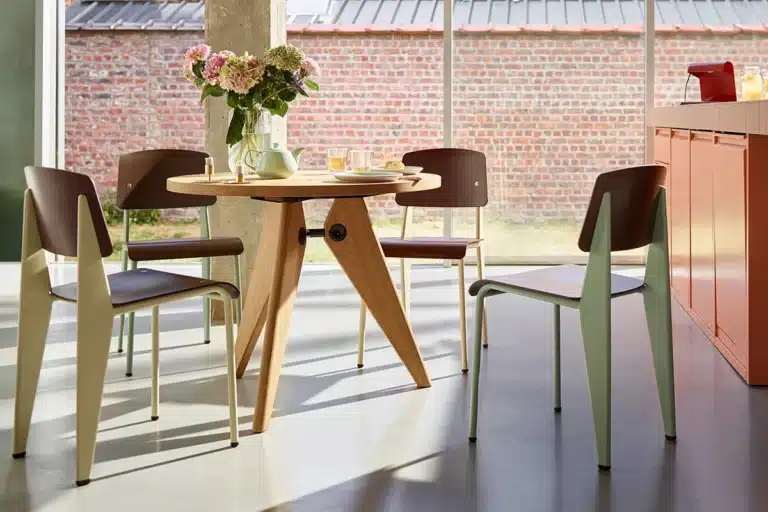
Often referred to as simply “The Standard” chair, Jean Prouvé’s classic dining chair is as versatile as it is timeless. The chair itself relies on the legs-back-seat combo made from separate pieces, which come together to offer an industrial look with smooth, polished edges.
Originally designed in 1934, Prouvé continued tweaking the design over time and throughout World War II when restrictions on metal inspired him to create an all-wooden version, as well as later iterations with stronger back legs. Today, modern productions of the chair by Vitra combine durable yet lightweight steel frames with polished, curved wooden seats and backs.
Masters Chair by Philippe Starck for Kartell

A fusion of classic designs into a single chair, the Masters Chair is an instantly recognizable and adaptable seat. Created exclusively from molded plastic by Kartell, the Masters Chair is the brainchild of modern design mavens Philippe Starck and Eugeni Quitlet. The duo set out to design a chair that paid homage to early iconic seats, combining the most famous designs from Jacobsen, Saarinen, and Eames into a single seat.
Frank Lloyd Wright Racine Guest Armchair by Steelcase

While architect Frank Lloyd Wright is best-known for his grand building designs, the furniture he designed for everyday tasks within spaces like the Guggenheim Museum, Fallingwater house, and SC Johnson’s Great Work Room are equally inspiring. Reissued by Steelcase, Wright’s signature Racine chair was originally commissioned for the Great Work Room in Racine, Wisconsin in 1939.
Blending classic American chair design in the form of upholstered ovals with Wright’s eye-catching architectural signature, the chair’s combination of curves and spaces invites inquiry from afar and a long, comfortable rest once seated.
Bellini Chair by Mario Bellini for Heller

Designed in 1998 by celebrated Italian architect and designer Mario Bellini, the Bellini Chair was the first piece of furniture Heller ever produced. Made in the USA, this indoor-outdoor chair is stackable up to six high with a dynamic contemporary style. The sturdy polypropylene construction gives added comfort thanks to a flexing back and light surface texture.
Panton Chair by Verner Panton for Vitra

Made from a single piece of molded plastic, the Panton chair was revolutionary upon its debut at the Cologne Furniture Fair. Today, the swooping icon remains extremely popular for its bold shape and exceptional comfort. Created by experimental Danish designer Verner Panton, the chair was reportedly rejected by over a dozen manufacturers before Vitra designed a process for manufacturing the now-legendary seat.
Sleek and stackable, the Panton chair’s unique shape injects a dose of whimsy and artistry into any dining spaces it occupies, inviting visitors to relax and play.
Cherner Armchair by Norman Cherner for Cherner Chair Company

Series 7 Chair by Arne Jacobsen for Fritz Hansen

One of Arne Jacobsen’s most popular and long-lasting designs, the Series 7 has been duplicated all over the world, but never matched in ingenuity. Inspired by the plywood bending technique popularized by Charles and Ray Eames, nine layers of pressure-molded wood veneer produce the minimalist but undeniably strong design that stands the test of time both in aesthetics and the construction of the design itself.
The Series 7 remains one of the best-selling chairs in design history and continues in production by Fritz Hansen to this day.
CH24 Wishbone Chair by Hans J. Wegner for Carl Hansen

Carl Hansen is a legend of Danish design and a seating master. With over 500 chair designs during his career, the right seat was his obsession—and the Wishbone became the crown jewel of his career. The chair itself is instantly recognizable for its curved, open back and ultra-simple hardwood silhouette. Notoriously time-consuming to craft, the chair combines a wooden frame with a seat made from over 100 feet of paper rolled into cordage. The result is a dining chair that is durable and comfortable with a springy seat.
In continuous production since 1950, the Wishbone chair is as popular today as it was upon its inception. Each seat is still hand-woven from paper cord, and Hans Wegner, often called the “master of the chair,” gave the design a lightness that keeps it welcome at tables of every style.
Navy Chair by Emeco

Emeco’s sleek Navy Chair captures the beloved shape of classic spindle-backed dining chairs, transforming the traditional form into a modern configuration by using all-metal construction. As its name suggests, the Navy Chair was originally commissioned from Emeco by the US Navy during World War II. Challenged to create a durable seat that could stand up to rough seas, saltwater and withstand torpedoes, the Emeco team developed the chair out of aluminum – which is also naturally fireproof.
Sustainable then and now, the design’s fusion of function and form has led to its nearly continuous production and dominance around tables worldwide.
How to Choose an Iconic Dining Chair
Selecting an iconic dining chair begins with the fundamentals. Standard dining seat height sits at roughly 18 inches; leave about 10 to 12 inches of clearance between the seat and the tabletop for comfortable dining. Consider scale, too—an oversized chair can overwhelm a small table, while a delicate frame may feel lost beside a substantial slab. Materials shape both aesthetics and upkeep: molded plastic and metal wear well in high-traffic homes, while wood and hand-woven seats reward a bit more care and attention. Comfort matters most for long meals; if arms are part of the design, confirm they tuck beneath the table without collision.
Many designers embrace the mix, pairing different icons around a single table rather than matching a full set—a collected approach that feels personal and considered. Start with our selection of dining chairs to discover silhouettes that speak to you.
Frequently Asked Questions
What makes a dining chair iconic?
A dining chair earns iconic status through design or manufacturing innovation, an instantly recognizable silhouette, and decades of continuous production. Recognition by museums and collectors—pieces held in permanent collections or sought after on the secondary market—further cements a chair’s place in design history.
What is the most iconic dining chair?
There is no single answer. The chairs cited most often are the Wishbone and the Eames Molded Plywood designs, with the Panton and Series 7 close behind. Each represents a different era and material breakthrough, and choosing among them comes down to personal affinity.
Are these iconic dining chairs still in production?
Yes. Most remain in production through their original or licensed manufacturers, including Vitra, Kartell, Knoll, Fritz Hansen, Carl Hansen & Søn, Herman Miller, and Emeco. Buying authentic pieces supports the makers who uphold the original craft and guarantees quality built to last.
Which iconic dining chair is most comfortable for everyday dining?
Chairs with contoured shells or hand-woven seats—such as the Wishbone, Series 7, and Eames molded plywood designs—tend to be the most comfortable for lingering meals. Upholstered versions add softness for those who prioritize cushioning.
From the simplicity of Prouvé’s standard dining chair in a kitchen breakfast nook to Verner Panton’s swooping modern masterpiece in a grand dining room, the right chair sets the tone for the space it inhabits. Today’s range of designs means our chairs can be as classic or avant-garde as any space.