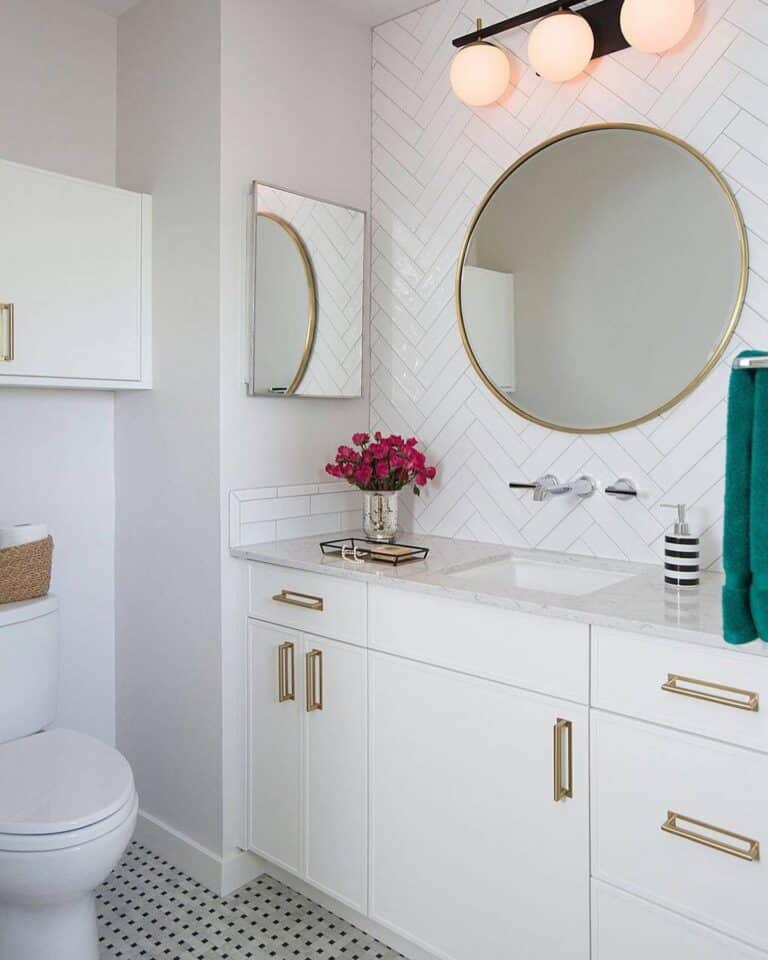
Alluria Bath Bar by George Kovacs
Image courtesy of reddezn
Lighting shapes how a small bathroom feels more than almost any other design decision. In a compact room, the darker it is, the smaller it feels, so a small bathroom should always read as bright and open. Knowing how to light a small bathroom comes down to one idea: layer several modest sources of light rather than rely on a single overhead fixture that flattens the space and casts shadows.
Good small bathroom lighting fully illuminates the room without overpowering it, which keeps the space from feeling cluttered or even smaller. This guide covers how to layer ambient, task, and accent light, where to place vanity and mirror fixtures, how to lay out recessed lights, and how to use light to make a small bathroom feel larger. Move beyond traditional bathroom lighting such as vanity lights, and focus on fixtures that maximize a small space for both design and light: lighted mirrors and medicine cabinets, undercabinet and tape lights, flushmounts, and recessed fixtures.
Layer Your Lighting: Ambient, Task, and Accent
Well-lit rooms rarely rely on one fixture. They combine three layers of light, and a small bathroom benefits from the same approach.
Ambient light provides overall fill. A flushmount or a few recessed fixtures wash the room in even illumination so nothing reads as dark.
Task light focuses where you groom. Fixtures at the mirror and vanity deliver bright, shadow-free light for shaving, applying makeup, and skincare.
Accent light adds depth. Tape or undercabinet light grazes a surface or fills a niche, giving the room dimension after the practical work is done.
In a compact space, two or three modest layers outperform a single bright overhead fixture. One strong ceiling light flattens the room, throws shadows under the brow and chin at the mirror, and leaves corners dark, all of which make a small bathroom feel smaller. Distributing light across layers keeps brightness even, softens shadows, and lets you shift the room from full illumination to a quiet glow. Putting each layer on its own switch, ideally on a dimmer, lets a single room serve a bright morning routine and low evening light from the same fixtures.
Lighted Mirrors and Medicine Cabinets
In small bathrooms, vanity lighting is often overlooked, as the space located around the mirror is limited. Instead, the vanity is usually illuminated by light cast from a ceiling light, which results in unwanted shadows and splotchy lighting. A great way to create the bright task lighting ideal for a vanity without having to worry about limited space around the mirror is to install a lighted mirror.

By combining the mirror and lighting into one, lighted mirrors are practical solutions for small spaces. Available in a range of shapes and sizes, these modern bathroom fixtures feature a traditional mirror surrounded by lights. Depending on the size and shape of the mirror, there is either a single light across the top, two lights along the left and right sides, or a halo of light all around.

Ambiance Mirrored Cabinet by Electric Mirror
Lighted medicine cabinets are another great lighting option, as well as space-saving storage solution, for small bathrooms. By combining lighting, a mirror and storage into one fixture, a lighted medicine cabinet is perfect for not only a bathroom with limited wall space but for one with limited counter space and storage as well.
Placement matters as much as the fixture. For even, shadow-free task light at the mirror, position light on both sides at roughly eye level, about 60 to 66 inches from the floor, rather than relying only on an overhead fixture. If you choose an over-mirror fixture instead, select one close to the mirror’s width so the light spreads across the full surface.
Undercabinet and Tape Lights

In a small bathroom, every amount of surface space counts. Even the space under cabinets and countertops should not be overlooked. Typically the area under a shelf, cabinet or countertop is hard to light, resulting in a dark space that inevitably causes the room to feel smaller. To combat poorly illuminated shelves or open counter space located under cabinets, install undercabinet lights or tape lights.
Tape lights are another great way to add a layer of light to a small bathroom. These LED lights provide a warm glow that is perfect for hard-to-light spaces, such as below a vanity or in a recessed niche, because of their flexibility. In addition to the light they provide, strip lights are easily tucked away out-of-sight for a neat, tailored look that will keep a small bathroom from feeling cluttered. Set on a low output, this same accent layer doubles as gentle nighttime light, enough to move through the room after dark without switching on the full overhead fixtures.
Flushmounts and Ceiling Fixtures

Jacqueline Flushmount by AERIN for Visual Comfort Signature
Image courtesy of mama.manhattan
To keep a small bathroom feeling open and spacious, refrain from installing any large or decorative ceiling lights. Instead, a flushmount is the ideal option.
A bathroom ceiling light mounted flush against the ceiling blends with the architecture of the room. When illuminated, the diffuser evenly distributes the light throughout the space. Flushmount lighting can help a small bathroom feel more open and uncluttered, whether the fixture is minimalist or more ornate. In addition to fully illuminating the space, the diffused light from the ceiling light will soften the bright light cast from the vanity light or lighted mirror.
Recessed Lighting Layout for a Small Bathroom

Recessed fixtures make an efficient ambient layer in a compact bath because they sit flush in the ceiling and take up no visual space. A few well-placed lights deliver uniform fill without a bulky fixture overhead.
Choose small-aperture housings, generally 3 to 4 inches, which suit the scale of a small room and spread light evenly. Space them roughly every 2 feet, starting about 2 feet from the walls, so the beams overlap and leave no dark patches or harsh pools of light.
Most small bathrooms need only two to four recessed lights, depending on the layout and whether other fixtures carry part of the load. A 5-by-8-foot bath often works with three: one near the entry, one over the main floor area, and one at the vanity to reinforce the task layer.
Frequently Asked Questions About Small Bathroom Lighting
What Lighting Is Best for a Small Bathroom?
The best approach layers three types of light: ambient fill from a flushmount or recessed fixtures, task light at the mirror and vanity, and accent light such as tape or undercabinet strips. Layering keeps a small room evenly lit and free of shadows, which a single overhead fixture cannot do. Match each fixture to the scale of the space so nothing overpowers the room.
How Many Lights Does a Small Bathroom Need?
Plan for roughly 70 to 80 lumens per square foot. A 40-square-foot bathroom needs about 2,800 to 3,200 lumens total, spread across ambient, task, and accent sources. Distributing that output across a few fixtures produces more even light than one bright fixture does.
Should the Vanity Light Go Above or Beside the Mirror?
For even, shadow-free task light, mount fixtures on both sides of the mirror at roughly eye level, about 60 to 66 inches from the floor. Side lighting illuminates the face directly and avoids the downward shadows an overhead fixture casts under the brows and chin. If you use an over-mirror fixture, choose one close to the mirror’s width so the light spreads across the full surface.
Is Warm or Cool Light Better for a Small Bathroom?
Use a neutral-to-cool white, around 3500 to 4000K, at the vanity for accurate color and clear grooming light. Warmer light suits the ambient and accent layers, where comfort matters more than precision. Keeping the vanity slightly cooler than the surrounding light gives you both function and a relaxed overall feel.
How Do You Light a Small Bathroom With No Window?
With no daylight to fill in, layer all three types of light so the room stays bright and dimensional. Add accent light, such as undercabinet or niche lighting, to remove the dark corners that make a windowless room feel closed in. A neutral-to-cool vanity light keeps grooming accurate where natural light is absent.
Can You Use Recessed Lights in a Small Bathroom Shower?
Yes, as long as the fixture is rated for the location. Choose a wet- or damp-rated recessed light over a shower or tub, where it meets direct water and steam. Match the rating to the spot rather than installing a standard housing throughout.
A small bathroom offers plenty of options for lighting it well. Choose fixtures that layer ambient, task, and accent light, place them to keep the room even and shadow-free, and the space feels brighter, larger, and more considered. Start with the mirror and vanity, add an ambient layer overhead, and finish with accent light to give the room depth.