A well-lit patio extends your home into the evening hours, creating space for dining, entertaining, and quiet relaxation under the night sky. The right outdoor lighting balances ambiance with practical concerns, transforming your patio into a space that feels inviting, safe, and secure.
Good lighting is a necessary requirement for outdoor spaces to feel inviting, safe and secure. Safety is critical, considering that dark outdoor spaces can be obstacle courses designed to twist ankles and break wrists. And when it comes to security, properly lit outdoor spaces make your home less of a target for crime.
This guide walks through a zone-by-zone approach—entertainment, safety, and security—and shows how to layer ambient, task, and accent lighting to achieve the right effect for each area.
What to Light: The Three Zones of Your Patio
Before choosing fixtures, identify the distinct zones in your outdoor space. Each requires a different lighting approach, and together they form the foundation of a thoughtfully lit patio.
- Entertainment Spaces: Well-lit patios, decks, and balconies can transform a larger outdoor space to be enjoyed more fully. Dining tables, lounging areas, and fire pits also fall into this area.
- Safety Spaces: Look for edges between landscape surfaces, like the edge of a patio and lawn, and spaces where heights change, such as stairs and decks.
- Security Spaces: Front and back doors, side yards, driveways, and mailboxes are all areas to consider.
How to Light It: Layering Ambient, Task, and Accent Light
Think about how the space is to be used and plan the outdoor lighting around that. Plotting out your lighting—and remembering the importance of light layering—is critical to getting the right effect and being able to create spaces for different uses.
Lighting Entertainment Spaces

This is the densest and most decorative of your outdoor spaces. This is also where the most exciting new developments in lighting design are happening. Look at everything from outdoor pendants to table and floor lamps. The range of fixtures offered for outdoors is exploding, with more types and styles than ever.
The key here is getting enough lighting without overdoing it. You do not need the same level of light outside that you have indoors. A lot of lighting can actually be detrimental to the enjoyment of your outdoor space. When you move from a light space to a dark one, your eyes dilate to allow more light in. Bright lights or glare will reverse this, making it harder to see in a nighttime environment.
Glare is defined as a bright or dazzling light. For our purposes, it is easily defined as any exposed light source that would cause you to squint. Exposed light sources beyond vintage-style filament bulbs are best avoided.
The trick to getting a well-lit outdoor patio is directing the light just where you need it. When it comes to ambient lighting, overhead lighting is a great option, be it outdoor pendants or even string lights. A good, sturdy string light zig-zagged over a dining or entertaining space lays down a soft, overall light and creates an atmosphere like a French café or Italian piazza.
String and Rope Lighting
String lights remain one of the most effective ways to bring ambient warmth to an outdoor entertaining space. When installing, consider running them in a zig-zag pattern or creating a canopy effect over dining and seating areas. Choose strands rated for wet or damp locations to ensure longevity through seasons of weather. A warm color temperature—around 2700K—creates inviting ambiance without the harshness of cooler tones. For a more subtle treatment, rope lighting tucked along railings, pergola beams, or planter edges adds a soft glow that defines the space without dominating it.

Wall sconces can also add an artful vibe to the ambiance. A visually striking wall sconce can serve as wall art, especially when juxtaposed to other pieces that stand out in the soft light. Be sure to use lights that are up/down lights that puddle light on the ground and not ones aimed out into space. By itself, this kind of fixture will only service a space of a limited depth. So, while appropriate for defining the borders of your outdoor space, with deep patios and decks you’ll want to incorporate other fixtures to spread light evenly throughout.

If a fan is needed, there are plenty of outdoor fans that offer lights as well. This is perfect for environments where temperatures don’t drop at night. Keep in mind, though, fans may not provide the most aesthetically pleasing light options.

Photo by nicolediannephoto, courtesy of Studio Plumb.
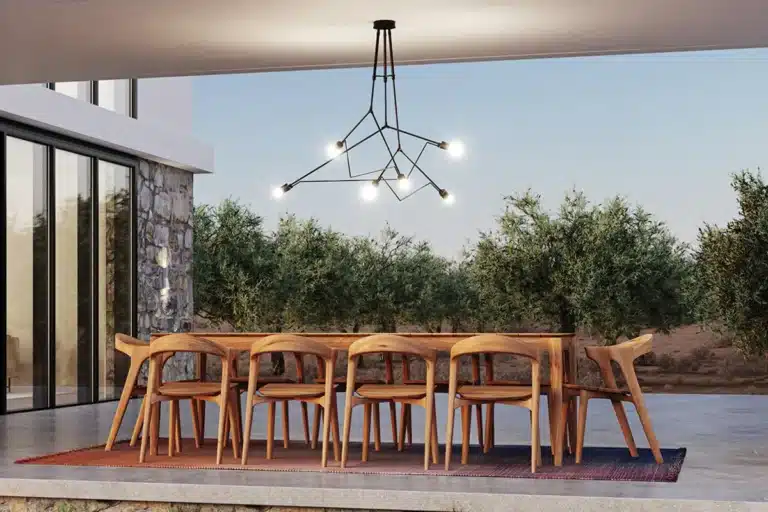
For covered patio spaces, you can go with outdoor pendants, flushmount ceiling fixtures or even recessed lighting. Make sure you select fixtures rated for the outdoors and put them on a dimmer so you can control the light output.

When it comes to task lighting, though, crank that dimmer up. Common outdoor activities like games or grilling require brighter, more direct lighting. For common spaces where games or reading might be done, make sure you specify overhead lights with enough output to work or play under.
If overhead is not an option, portable table or floor lamps can also do the trick. There are a growing range of gorgeous, chargeable table lamps that will give you hours of entertainment. Plug-in floor lamps are also growing in popularity in outdoor settings, and give a polished, high-end look. For specific tasks like grilling, look for targeted fixtures like barbeque lights to give you the precise light you need.
Cordless, Rechargeable, and Solar Options
For patios without convenient outlets, cordless and rechargeable fixtures offer flexibility without compromising on design. Many modern rechargeable table and floor lamps deliver hours of light on a single charge and can be moved throughout the space as needed. Look for models with dimmable settings, allowing you to adjust brightness from task-level illumination down to soft ambient glow as the evening progresses. Solar-powered path lights and accent fixtures provide another outlet-free solution, charging during the day and activating automatically at dusk. These work well in areas that receive consistent sunlight and are particularly suited for landscape accents and pathway definition.
Lighting Safety Spaces

A well-designed outdoor space accounts for your guests’ lack of familiarity with it. While you may be able to walk around your backyard in a blindfold, guests likely cannot. To illuminate potential hazards, ambient landscape lighting is ideal. Uplighting trees or hedges is a great way to add to the overall light of the space while creating boundaries that are easily noted.
From there, focused task lighting can provide safe illumination of water taps, electrical breakers and any other kind of landscaping controls. Step or deck lights placed above a technical component can be a lifesaver in a hectic situation.
Accent lighting is probably the most critical category in this space. Good accent lighting can make or break the sense of safety. Changes in elevation like stairs or curbs can be treacherous. Step lights, path lights and bollards help ensure that we can move around an outdoor space easily and safely. Ensure these light sources are low to the ground to focus light where it’s needed and not create glare.
Lighting Security Spaces

Finally, there’s the issue of your outdoor space’s security. While a good security system is key, good outdoor lighting can expand your safe area and give that system an extra buffer.
Congregational spaces like front doors, side doors or breezeways—wherever you may need to pause and dig around for keys—should have adequate ambient lighting. You can accomplish this with well-placed wall sconces or overhead lighting. Flood lighting can also be used for extreme cases but is generally a more aggressive style of lighting, blinding anyone on the receiving end.
Motion and photo sensors are great power-saving additions for any outdoor lighting setup. Motion sensors can be included on a fixture or, more gracefully, added to a circuit so any fixture can be used. For more commonly used spaces, a photo sensor—often called a photocell—works to turn the fixture on and off with the celestial changes and saves you flicking that switch twice a day.
Patio Lighting Fixture Quick Reference
| Fixture Type | Best Zone | Lighting Layer |
|---|---|---|
| String lights | Entertainment | Ambient |
| Outdoor pendants | Entertainment (covered) | Ambient / Task |
| Wall sconces | Entertainment, Security | Ambient / Accent |
| Path lights | Safety | Accent |
| Bollards | Safety | Accent |
| Step / deck lights | Safety | Accent |
| Landscape spot / flood | Safety, Security | Accent |
| BBQ / task lights | Entertainment | Task |
| Motion-sensor sconces | Security | Task |
Frequently Asked Questions
What is the best type of lighting for an outdoor patio?
The most effective approach combines ambient, task, and accent lighting. Ambient light from pendants, string lights, or wall sconces sets the overall mood. Task lighting provides brightness where specific activities happen, such as grilling or reading. Accent lighting defines boundaries and highlights potential hazards. Matching fixture types to your patio’s distinct zones ensures balanced illumination without overdoing it.
What are the best no-plug or solar options for a patio?
Rechargeable portable lamps are ideal for patios without convenient outlets—many offer hours of light on a single charge with dimmable settings. Solar-powered path lights and accent fixtures charge during the day and activate at dusk, making them well suited for landscape accents and pathway definition. Weather-rated string lights on a timer provide another outlet-free solution for overhead ambiance.
What is the most durable outdoor lighting?
Look for fixtures rated for wet or damp locations, depending on your exposure. Materials like solid brass, copper, marine-grade stainless steel, and powder-coated aluminum resist corrosion and weather well over time. Checking the UL wet or damp rating ensures the fixture is built to handle the conditions of your specific space.
How much lighting does a patio need?
Enough to feel comfortable without creating glare. You do not need the same level of light outside that you have indoors—in fact, too much light can be detrimental to enjoying the space. Installing fixtures on dimmers allows you to adjust output as needed, dialing up for tasks and back down for evening relaxation.
How do I light my patio for entertaining, safety, and security?
Approach your patio as three overlapping zones. Entertainment spaces benefit from layered ambient and task lighting for dining and activities. Safety spaces require accent lighting to mark elevation changes and boundaries. Security spaces need well-placed wall sconces at entry points and motion-sensor fixtures for less-trafficked areas. The sections above walk through each zone in detail.
A well-lit patio balances ambiance, safety, and security by matching the right fixtures to each zone and layering ambient, task, and accent light throughout. Start by identifying the areas you use most, then build out your lighting plan with fixtures rated for the outdoors and placed on dimmers where possible. The result is an outdoor space that invites you outside long after sunset.