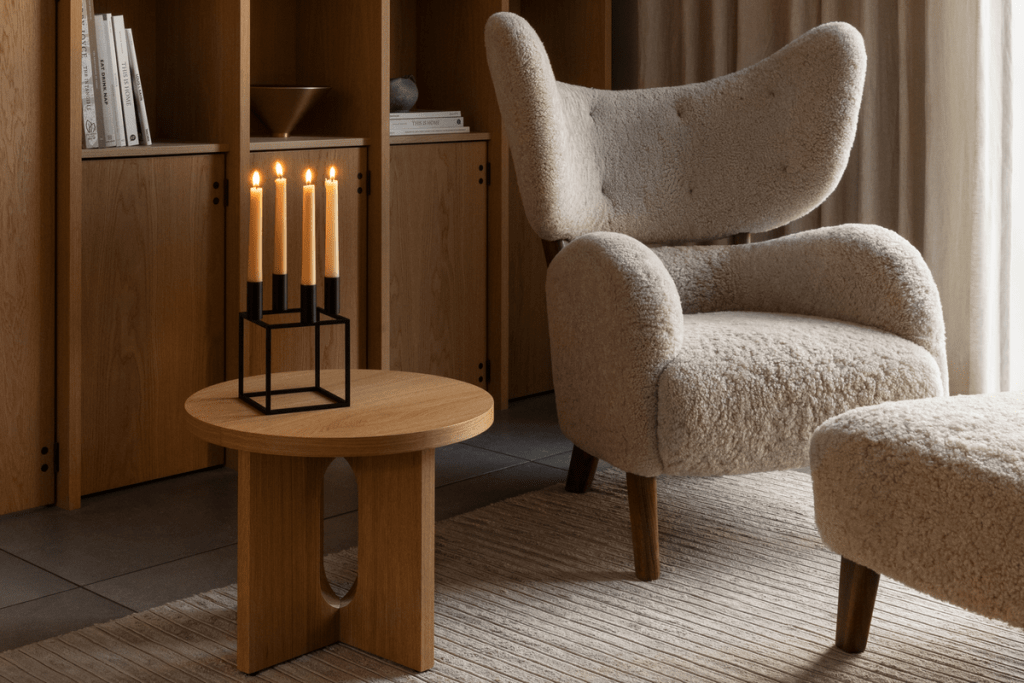
Light is the first signal of the day. Before a clock is ever consulted, it has already told the body when to rise and when to rest. Circadian lighting is designed around that instinct, carrying a room from clear, generous light in the morning to a low amber glow by evening.
For the designer, it requires no new vocabulary. Ambient, task, and accent light remain the instruments; circadian design simply sets them to the hours. What follows covers the science of the body clock, the fixtures and controls that make it possible, and its application room by room, whether in a private residence or a client’s.
What Is Circadian Lighting?
Circadian lighting is interior lighting that follows the natural progression from daylight to dusk. It adjusts brightness and color through the day in step with the circadian rhythm, the roughly 24-hour cycle that governs sleep and energy.
It is also known as human-centric lighting, a term that places the emphasis on how people feel and function within a space. The rhythm itself is kept by the body’s master clock, a cluster of nerve cells known as the suprachiasmatic nucleus. According to the National Institute of General Medical Sciences, it regulates melatonin in response to the light the eyes receive.
That response is what a circadian scheme is built on, and it depends on two qualities of light: when it arrives, and what color it carries
How Light Sets Your Body Clock

The principle is simple. Bright, cooler light in the morning signals alertness and keeps melatonin low. Warm, dim light in the evening allows it to rise, easing the body toward sleep.
Color matters as much as timing. Blue-enriched light has the strongest effect on the body clock: research summarized by the National Institutes of Health places peak melatonin sensitivity between 446 and 474 nanometers, centered near 460 nm.
Warmer light, in turn, offers less circadian stimulation, and cooler light offers more. That makes color temperature one of the most precise tools a designer has. For the fundamentals, see our Kelvin color temperature guide.
Why Circadian Lighting Matters

Even ordinary evening light leaves a mark. In a Harvard sleep study, typical room light before bedtime delayed melatonin onset in 99% of participants and shortened its duration by about 90 minutes.
Over time, those evenings accumulate. The National Institute of General Medical Sciences links ongoing sleep loss and disrupted circadian rhythms to long-term health risks.
The reverse holds as well. In controlled research published in the journal Sleep, participants under circadian-informed lighting gained 52 minutes of sleep and 9% greater sleep efficiency. Results at home vary by person and setup, but the direction is clear: light that works with the body’s clock tends to repay it in rest.
How Circadian Lighting Works: Tunable Light and Smart Controls

A circadian scheme adjusts two qualities across the day: color temperature and intensity. Cooler and brighter by day, warmer and lower by night.
Specialists measure circadian effect in equivalent melanopic lux (EML). Melanopic lux is a measure of how strongly light affects the body’s clock, rather than how bright it appears to the eye.
The WELL Building Standard recommends at least 250 EML in living environments during the day and no more than 50 EML in the evening. A light meter isn’t necessary at home, but those two figures explain why a sunlit breakfast nook and a candlelit dinner feel so different.
Tunable White LED Fixtures and Bulbs
Tunable white describes a fixture or bulb that can shift its color temperature across a range, commonly from about 2700K to 5000K, from the warm glow of an evening lamp to the clarity of late-morning daylight.
LED technology makes that shift efficient and precise. Integrated fixtures suit rooms designed around the light, while tunable bulbs bring a favorite lamp into the scheme. Explore modern LED lighting to see the sources a tunable plan is built on.
Dimmers, Controls, and Smart Scheduling
Dimming lowers intensity as evening arrives. Paired with tunable sources, the right controls automate a warm, low wind-down with no adjustment by hand.
Smart systems go further, scheduling the shift from cool to warm so it follows the day on its own. With ambient, task, and accent light layered, each fixture can take on a different role from morning to night.
Designing a Circadian Scheme, Room by Room
| Room or Use | Time of Day | Light to Choose |
|---|---|---|
| Kitchen, home office | Morning and midday | Cooler, brighter task light for focus |
| Living areas | All day | Tunable fixtures that flex from bright to warm |
| Bedroom, reading nooks | Evening | Warm, dimmable, low light for wind-down |
Getting Started With Circadian Lighting

A circadian scheme comes together in a few clear steps.
- Audit each room. Note which spaces need bright daytime light and which are for winding down.
- Choose tunable white sources. Begin with the rooms used most, then expand over time.
- Add dimmers and smart controls. These automate the shift from cool morning light to warm evening light.
- Set a simple schedule. Cooler and brighter early, warmer and lower after sunset.
- Lean on expert guidance. Lumens’ ALA-certified lighting specialists and the Lumens Trade team support professionals specifying human-centric lighting.
There is no need to convert the whole home at once. A circadian scheme can be phased in room by room, one space at a time. For the broader wellness picture, see our guide to lighting and health.
Circadian Lighting FAQ
What is circadian lighting in simple terms?
Circadian lighting shifts in color and brightness over the course of the day, keeping pace with the body’s natural clock. Morning light is cool and bright; evening light is warm and low.
Expert Tip: A circadian scheme is, at heart, a lighting plan with a timetable. Set the scenes once, and the light takes care of the rest
Does circadian lighting actually improve sleep?
Controlled research links circadian-informed lighting to longer, more restful sleep. At home, the effect varies with the person and the scheme.
Expert Tip: To start small, begin with the bedroom and the rooms that hold the last hours of the day. That is where evening light shapes the wind-down most.
Do I need special fixtures, or will smart bulbs work?
Either can anchor a scheme. Smart bulbs adapt the lamps already in a room; integrated fixtures give finer control where the light is part of the architecture.
Expert Tip: Put every tunable source in a room on one control system so they move together. Mismatched color temperatures side by side read as an error, never a mood.
What color temperature should I use at night?
In the evening, choose warmer, lower-intensity light. Warm light offers less circadian stimulation than cooler, bluer light, allowing the body to ease toward rest.
Expert Tip: Height matters as much as warmth. After dark, lamps placed below eye level make a calmer room than overhead light, even at an identical color temperature.
The finest lighting schemes have always done more than illuminate. They shape how a room feels at every hour. Circadian lighting makes that intention measurable: cool, generous light when the day calls for focus, and warm, low light when it calls for rest.
Begin with the rooms lived in most. A tunable pendant over the kitchen island, a dimmable sconce beside the bed, a warm reading lamp in the corner where the day ends: small, deliberate choices that add up to a home in step with the people in it. For a more complete scheme, our lighting specialists and the Lumens Trade team can help select fixtures for a human-centric home.