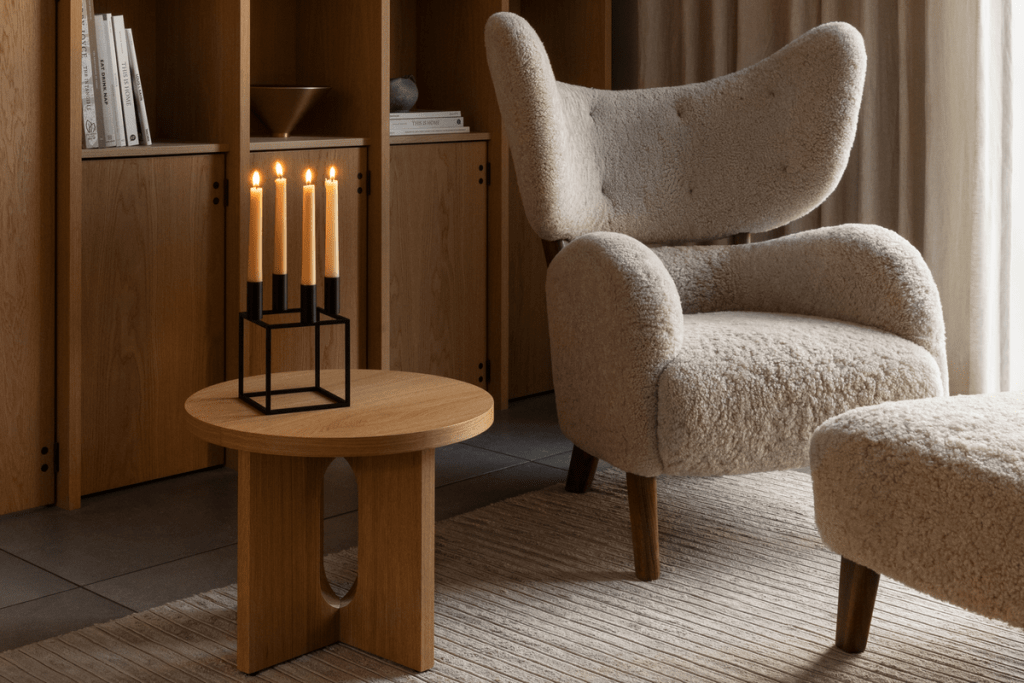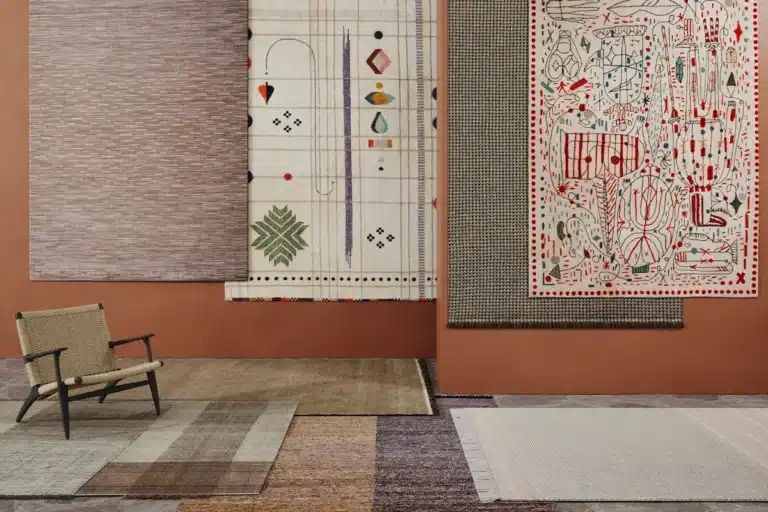
Whether used as a floor covering or hung on the wall like a work of art, rugs are a key element of interior design.
An area rug provides warmth, defines a space and provides the foundation for the style of a room. There are many considerations involved in buying a rug including location, size, color, pattern and durability. Our rug buyer’s guide will show you how to find the right rug size for the room, how to place it, decide which material works best and see the differences between various weaving techniques. Ultimately, choosing the right rug comes down to a handful of decisions: size, material, shape, color, and pattern. This guide walks through each one in turn.
Fitting a Rug to the Size of the Room
Finding the right size for a rug depends on several factors, such as the room’s dimensions, the furniture placed on it, the room’s function and the overall design of the space. Below are some general rules of thumb for picking the right size.
As a rule of thumb, leave roughly 12 to 18 inches of bare floor around the rug’s perimeter. That margin lets the surrounding space frame the rug rather than crowd it. Before committing to a size, outline the candidate dimensions on the floor with painter’s tape. This makes it easy to visualize the footprint and confirm the proportions before the rug arrives.
The chart below offers a quick reference for standard rug sizes by room, along with a placement note for each.
| Room | Common Sizes | Placement Tip |
|---|---|---|
| Living room | 5 x 8 or 6 x 9, 8 x 10, 9 x 12 | 5 x 8 / 6 x 9 anchors the coffee-table zone; 8 x 10 reaches the front sofa legs; 9 x 12 grounds the full room. |
| Dining room | Extend at least 36″ beyond the table on all sides | Chairs should stay on the rug even when pulled out. |
| Bedroom | 6 x 9, 8 x 10, 9 x 12 | Leave 18 to 24 inches of rug exposed along the sides of the bed. |
| Kitchen | Runner or 5 x 8 | Runner suits a galley layout; 5 x 8 works beneath an island or table. |
| Entryway/Foyer | 2 x 3 or 3 x 5, or a runner | Scale to the door swing and available floor. |
| Hallway | Runner, e.g. 2 x 8 | Leave a few inches of bare floor on each side. |
How to Size an Area Rug for the Living Room

Determining the right rug size for a living room depends mostly on the placement of the furniture.
Place the area rug in either the center of the room or the center of the seating area, such as under a coffee table.
Consider the size of the area that is to be covered. Knowing this, the most standard rug sizes for the living room are:
5 x 8 area rugs and 6 x 9 rugs: With a 5 x 8 rug, there will only be enough room to cover the area beneath and around the coffee table. The area under couches and beyond will go uncovered.
8 x 10 area rugs: With an 8 x 10 rug, the area beneath the coffee table and couches will be covered.
9 x 12 area rugs: A 9 x 12 rug will cover most of the floor in most living rooms, which leads to a more consistent look.
No matter which size is chosen, how the seating is positioned should be uniform. Seating should be positioned with either:
- No legs on the rug—often seen with 5 x 8 rugs and 6 x 9 rugs
- Two legs on the rug—often seen with 8 x 10 rugs
- Four legs on the rug—often seen with 9 x 12 rugs
If one chair has two legs on the rug, all chairs should have two legs on the rug. The added benefit of placing a rug under the seating means that the rug will stay in the same place.
Generally, it’s best to err on the larger side. This gives you more to work with when accommodating more difficult furniture pieces, such as sectional sofas.
How to Size an Area Rug for the Dining Room
The dining room rug size should be larger than the dining table. Dining chairs should not be off-kilter and rock unsteadily. Make sure to install a rug size that accounts for the distance chairs get pushed back when people are sitting in them. A good starting point is to add about 36 inches to the length and width of the table (or to the diameter, if it is round).
For smaller dining rooms and circular coffee tables, consider using a round rug. Generally, round rugs go with round dining tables, square rugs with square tables and rectangular rugs to go with rectangular tables. Make sure to have at least 36 inches of room between the edge of the table and the end of the carpet for round rugs, as well.
If the dining table is extendable, choose a rug based on the longest measurement of the table when it’s fully extended.
How to Size an Area Rug for the Bedroom
Nobody wants their feet to land on a cold hardwood floor first thing in the morning. Measure the bed and add anywhere from 18-24 inches to both sides. If there are nightstands, measure from the outer edges of both. Also account for any furniture that may rest at the foot of the bed, like an ottoman – two or four legs should fit on the rug.
Keeping that extra 18-24 inches needed for the sides of the bed, the most standard rug sizes for the bedroom are:
- 6 x 9 area rugs—fits twin, twin XL and full-sized beds
- 8 x 10 area rugs—fits queen, king and California king-sized beds
- 9 x 12 area rugs—used to cover more area in larger rooms
Another option for adding a rug to the bedroom is through the use of modern runner rugs. Instead of covering a large portion of the rug, add multiple runner rugs: two along the sides of the bed from the nightstand, and another at the foot of the bed.
Choosing Rug Color and Pattern
Every rug either makes a statement or recedes into the background, and deciding which role it should play is the first step. A bold color or graphic weave becomes a focal point, while a quieter, tonal rug offers a backdrop that lets furniture and art lead.
To keep a room cohesive, pull a color from the palette already present, whether from upholstery, drapery, or a favorite work of art. Pattern can do structural work as well, defining a seating area or connecting adjacent zones in an open floor plan.
Mixing patterns is entirely possible when approached with intention. Vary the scale so a large motif anchors the room while smaller patterns support it, and keep a shared color running through each piece to tie them together. In smaller rooms, lighter tones and low-contrast patterns help the floor feel more expansive, visually opening up the space. Explore options for every palette among our living room rugs.
Modern Rug Shapes: Abstract and Geometric
No longer confined to square or round shapes, modern rugs come in abstract shapes that look like parallelograms, overlapped ovals, hexagons or even stones.
The Parallelogram

The Double-Oval

The Hexagon
Lorem ipsum dolor sit amet, consectetur adipiscing elit. Ut elit tellus, luctus nec ullamcorper mattis, pulvinar dapibus leo.

The Stones

Rug Types: What's the Difference?
Part of the difficulty in picking the perfect rug is knowing what the options are. The different types of rug materials and rug weaves provide a very different type of rug that can serve different purposes. Here are some questions to consider:
- Will the rug be walked upon often with both shoes and bare feet?
- Is the rug expected to retain heat easily?
- Is machine-washable important?
- Should the rug shed?
Types of Rug Materials

Depending on the material selected, there will be varying degrees of softness, stain resistance, durability and price. Some of the most common materials found are:
Wool Rugs
Reliable, soft, stain-resistant and affordable, wool is a smart choice for most rugs. If living in a cold area, consider this material because it has excellent heat retention. On the downside, however, they are prone to shedding due to their tufted construction. It is common to vacuum the rug at least once a week.
Silk Rugs
The epitome of luxuriousness and softness, silk rugs are a wise choice for bedrooms. However, they are sensitive to moisture and are more delicate than cotton or wool. The elegance and comfort of these rugs often make them more expensive than other materials.
Natural Fiber Rugs
Crafted from jute, bamboo and seagrass, natural fiber rugs are perfect for the eco-friendly and are among the most affordable. Some can feel scratchy and rough, so make sure to test each one before buying to make sure they are smooth and comfortable. Natural fiber rugs go best in dry rooms with a low possibility of being stained, as they can be difficult to clean.
Synthetic Rugs
Durable, easy to care for and stain resistant, synthetic rugs are a good option for indoor/outdoor spaces. Though the most common materials are polypropylene and polyester, a variety of durable materials can be found in these types of rugs.
Cotton Rugs
Cotton rugs are nice because they are versatile and easy to clean. Though they are less likely to shed than their wool counterparts, they are less durable. They are machine-washable, so they are easier to maintain.
Cowhide and Leather Rugs
For a real statement piece of a rug, consider going the cowhide route. The lay-flat rugs add a sleek, modern element to a space; another possibility is a plush, leather rug with a shag option if you’re looking for something more comfortable to lounge on. Cowhide rugs are often in an odd shape, making them perfect for nooks, crannies and angled rooms of the home.
Sustainable Rugs
A leader in Fair Trade practices as well as sustainability in the rug industry, Nanimarquina is leading the way on sustainable rugs. “We strive to enhance our work with the use of biodegradable and recycled products, experimenting with different types of textures and fibers. Our traditional production techniques further contribute toward preserving natural resources for the use and enjoyment of future generations.” —Nanimarquina.
To go a step further into the fight against environmental degradation, Nanimarquina has introduced Eco-wash in the cleansing of its collections: the natural washing product Ecosheen is a biodegradable and free-of-chemicals multienzyme washing product, while powers the bright colors, shine and softness of each fabric.

Offcuts and leftover wool yarn are collected for reworking into the ingeniously sustainable Re-Rug Area Rug by Nanimarquina.
Another champion of sustainable floor coverings is Chilewich. The brand’s proprietary manufacturing process for rugs, mats and placemats uses yarn that has a minimum of 18% renewable vegetable content and is free of toxic materials. The plasticizer is derived from soybeans rather than petroleum for 40% reduction in greenhouse gas emissions as well.

Types of Rug Weaves
An area rug’s weave has a huge impact on how it feels and how it will have to be maintained. Here are some of the most common weaves:
Hand-Knotted Rugs

As the name implies, this technique involves the rug fibers being knotted by hand on a loom. This time-tested method creates durable rugs that will last a lifetime. However, this technique comes at a higher price.
Tufted Rugs

Attached to a latex backing, tufted rugs are made by trimming the tops of loops of yarn to create a flat, plush surface. Easy on the wallet, these rugs come in a wide variety of styles. Just keep in mind that they are prone to shedding and require frequent vacuuming.
Hooked Rugs

Hooked rugs are similar to tufted rugs, but in this instance, the tops are not lopped off, giving the rug a nubby and textured quality. This is beneficial because they shed less.
Flatwoven Rugs
Reversible with the pattern visible on both sides, flatwoven rugs are great for high-traffic areas like entryways and living rooms. They are mat-like rugs that are versatile and durable. They do not come with any backing, however, so a rug pad is highly recommended.
Machine-Made Rugs

Proper Rug Care and Rug Pads

Unless the rug has a built-in rubber backing, a rug pad is necessary. Since rugs are usually used on hard, smooth surfaces, a rug pad provides friction to keep the rug from sliding around. A rug pad provides safety while preventing damage to the underside of the rug. Some rug pads work on both hardwood floors and carpet, allowing for versatility in how the room looks. In wet locations, the right rug pad promotes air circulation so the rug dries more quickly. Higher air flow also allows for easier vacuuming. A proper rug pad is slightly shorter than the rug itself as to avoid being seen.
Cleaning Your Rug
In addition to regular vacuuming, follow the manufacturer’s directions when it comes to cleaning your rug because different materials require different processes. When spot cleaning, make sure to test the cleaning solution somewhere inconspicuous in order to make sure it is color-safe for your rug. Most rugs will shed for weeks if not a few months of vacuum cleaning and vacuuming more often is usually a good idea until shedding subsides.
Frequently Asked Questions
How much bare floor should I leave around a rug?
As a rule of thumb, leave roughly 12 to 18 inches of bare floor around the rug’s perimeter. When you are unsure, err toward the larger margin.
What size rug do I need for a living room?
A 5 x 8 or 6 x 9 covers the coffee-table zone, an 8 x 10 reaches the front legs of the surrounding sofas, and a 9 x 12 grounds most rooms fully. Whichever size you choose, keep the furniture legs in a consistent position.
Which rug material holds up best in high-traffic areas or homes with pets?
Synthetic and flatwoven rugs are durable and stain-resistant, which makes them well suited to busy rooms and homes with pets. Wool is a resilient natural workhorse that stands up well to daily wear.
Do I really need a rug pad?
Yes, unless the rug has a built-in rubber backing. A pad keeps the rug from slipping and protects both the rug and the floor beneath it.
Should furniture legs sit on the rug?
All-off, front-two, or all-on placements are each valid. The key is consistency: keep every piece of furniture in the same relationship to the rug.
Which rug weave lasts longest?
Hand-knotted rugs are the most durable weave and can last a lifetime with proper care. That longevity comes at a higher cost.