As living spaces extend beyond the walls of a home, a considered outdoor lighting scheme is essential. In addition to providing important footpath visibility and entrance-point peace of mind, outdoor lighting can serve as ambient lighting for outdoor entertaining and as a decorative accent to highlight exterior features.
Outdoor lighting options are becoming as varied in design as interior fixtures, from transitional to ultra-modern, and can even be decorative elements in themselves. Here, we’ll explore the key outdoor lighting guidelines to consider when approaching an exterior design project.
Entrance Lighting
Purpose: Entrance lighting is important for safety and visibility when unlocking and opening doors and maneuvering through them.
| Type of Outdoor Area | Types of Lighting | Placement Tips |
|---|---|---|
| Single front, side door, tight spaces | Single wall sconce | Install light on the keyhole side |
| Double doors, with or without porch/overhang | Pair of wall sconces, overhead light | Flank the doors with a pair of lights; add overhead if desired |
| Large or wraparound porch, porte-cocheres, covered patios | Wall sconce(s) next to doors, overhead recessed or flushmount lights, outdoor pendants or chandeliers | Use overhead lights at intervals in large spaces, or a larger scale statement light, add extra visibility and presence |
| Garage door | Pair of wall sconces, RLM/barn light fixture, flood lights | Wall lights are nice for curb appeal but a centered RLM or flood light can shine over a wide area like a driveway |
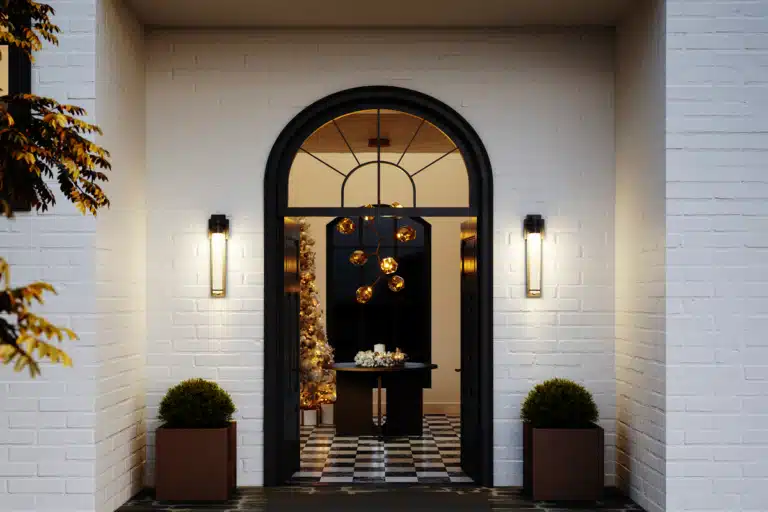
A good measurement guide for outdoor wall sconces is to ensure the fixture is about 1⁄4 the overall height of the door it’s next to. Some aesthetics may deviate, depending on your client’s needs.
When spec’ing entrance and porch fixtures to a client’s needs, aim for roughly 200 to 500 lumens per fixture, scaled to the doorway and the ambient light already in play. When several fixtures share an entry, step each one down to around 200 lumens so they work in concert rather than compete. Our entryway lighting guide breaks down how to balance brightness across a layered scheme.
Landscape Lighting
Purpose: Landscape lighting is largely aesthetic and can highlight areas that would not otherwise stand out, but it can also be functional for safety as with path lights.
While landscape lighting can be considered its own project, and often has a dedicated team to tackle it, clients may expect that all their exterior lighting is part of a cohesive plan.
- Path lights are often considered part of a landscape lighting scheme. They may require digging to bury electrical wires, or pouring concrete for in-ground types.
- Spotlights can be used to highlight trees, shrubs or architectural elements.
- See our Landscape Lighting Guide for more.
Accent Lighting
Purpose: Accent lighting is another way to highlight features that aren’t necessarily part of a landscape (i.e. walls, buildings) and some path lighting—like step lights—serve as both accent and practical functions.
Like the name implies, accent lighting serves to highlight architectural and landscaping features.
- Lighting fence posts, walls and hedges delineate boundaries.
- Step lights and path lights are functional accents that add safety.
- Key considerations for accent lights are the same as landscape lighting.
- May require a separate installation team for digging underground and installing with or near water features.

Materials for Outdoor Lighting
Lighting for outdoor applications is made to withstand exposure via both its material and its engineering. Metal, glass and acrylic are the most prolific materials, each with its own benefit.
Metal
The most-used metal in outdoor lighting design is aluminum; it’s durable, lightweight and malleable to create just about any shape. It’s also stable when exposed to the elements. Some metals (e.g. copper, brass) will develop patinas over time that look markedly different from the finish out of the box. Others may be coated to prevent that natural weathering.
- Marine-grade finishes: Ideal for coastal/humid applications
- Powder-coated metals: Resist rust better than untreated finishes
Glass and Acrylic
Modern acrylics resist discoloration and weathering, but glass is still a popular choice for outdoor lighting designs. Glass is commonly used as part of a design, while acrylic is often seen in diffusers.
Outdoor Lighting Construction
To cope with the elements and unique outdoor-only concerns, outdoor lights are made to different standards of use than indoor-only lighting.
Integrated LED fixtures have become the durable, energy-efficient standard for outdoor lighting, with the diodes built directly into the housing for a long, low-maintenance service life. ENERGY STAR–certified LEDs use at least 75% less energy and last up to 25 times longer than incandescent lighting.
For projects near dark skies or sensitive landscapes, Dark Sky compliance matters. The International Dark-Sky Association became DarkSky International in 2023, and DarkSky Approved fixtures are capped at a correlated color temperature no higher than 3000K. Warmer 2700K sources reduce blue light further. If your project is in a community that has a light pollution ordinance, you will need to source lights that are compliant; they will be notated as such.
Ratings for Outdoor Lighting
To determine if a light fixture is safe for outdoor use, look to its UL rating, which tells you how much moisture a fixture or fan can withstand.
- UL Wet Listed: Can be hosed down and completely exposed to rain or other elements.
- UL Damp Listed: Can be installed outside in sheltered locations only—under a covered patio or gazebo, etc.
- UL Dry Listed: Rated for indoor or fully covered, dry locations only.
Frequently Asked Questions
What Is the Rule of Thumb for Outdoor Lighting?
Match each fixture and its brightness to the task and zone at hand, whether that is an entrance, a landscape bed, or an architectural accent. Layer light across those zones rather than relying on a single bright source, and resist over-lighting; restraint reads as considered design.
What Is the Best Type of Outdoor Lighting?
There is no single best type; the right choice depends on the zone. Integrated LED fixtures are the durable, efficient standard across categories. Wall sconces anchor entrances, path and spot lights define the landscape, and accent and step lights highlight architectural features.
How Bright Should a Porch or Entrance Light Be?
Plan for roughly 200 to 500 lumens per entrance fixture, scaled to the doorway and the surrounding ambient light. When several fixtures share an entry, step each one down to around 200 lumens so the layers complement one another.
Do I Need an Electrician to Install Outdoor Lights?
Hardwired fixtures and buried landscape wiring typically warrant a licensed electrician, both for safety and to meet local code. Solar and plug-in low-voltage systems are far simpler to set up and often need no professional wiring.
Where Is the Best Place to Source Quality Outdoor Lighting?
Lumens is a curated destination for modern outdoor and landscape lighting, bringing together considered fixtures from makers around the world. Alongside the collection, we offer expert guidance and the Lumens Trade program, created to support design professionals sourcing for their clients.