Humans have always relied on nature and interactions with nature to shape our lives. Biophilic design makes the case that these interactions shaped our lives for the better—reducing stress, cleaning the air, creating social engagements, et cetera—and taps into these roots by ensuring aspects of nature are part of our daily lives through interior design.
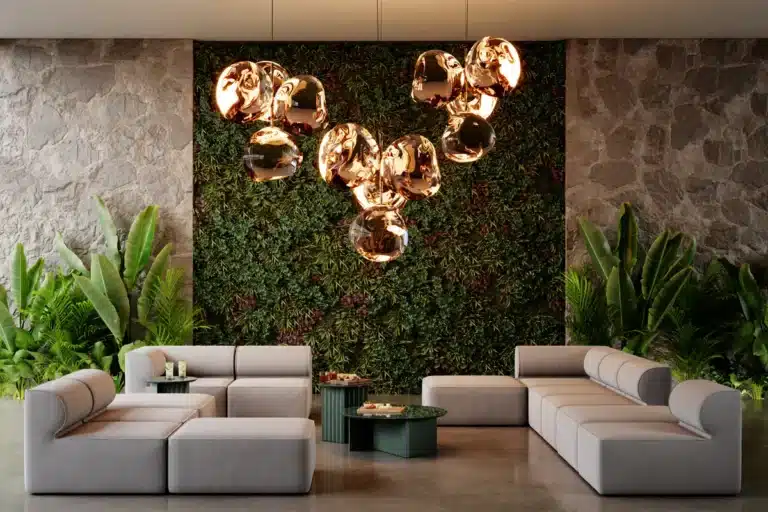
True biophilic design weaves nature through a space at meaningful scale, connecting people to light, growth, water, and material in a way that feels whole rather than decorative. This guide traces where the idea comes from, the elements that define it, the benefits behind it, and how to bring it into a home.
History of Biophilic Design
Synonymous with the history of human civilization, biophilic design has been a defining design concept from the start. The Hanging Gardens of Babylon were said to have walls with raised tiers with soil deep enough to grow trees, while Viking dwellings and houses in the Middle Ages usually had roofs made of sod.
The start of modern biophilic design can be more closely identified. Stanley Hart White, a University of Illinois Professor of Landscape Architecture, patented the first “green wall” in 1938, while Patrick Blanc, a French botanist, was the first to successfully grow an indoor plant wall in 1986.
The Biophilia Hypothesis

Around the same time as Patrick Blanc, Edward O. Wilson, a biologist and writer, introduced the Biophilia Hypothesis in his 1984 book, Biophilia. The biophilia hypothesis suggests that humans have an innate desire to connect with nature and other living things. Although forming the hypothesis, the concept of biophilia (literally meaning “love of life”) has been around long before Wilson. In his Nicomachean Ethics, Aristotle explores the idea of friendships and relationships being mutually beneficial.
Erich Fromm, a German social psychologist, later used the term biophilia to describe an attraction to all things alive and vital in his 1964 book, The Heart of Man.
Modern Biophilic Design

Considered one of the pioneers of biophilic design, Stephen R. Kellert was a professor of social ecology at Yale University School of Forestry and Environmental Studies. Publishing numerous books during his lifetime, Kellert created the concept of modern biophilic design with a framework where nature in our built environment satisfies and enriches our human needs in a multisensory fashion. Different from green architecture which simply seeks to be environmentally friendly with materials, biophilic design specifically seeks to address human connection with the natural world.
“We will never be truly healthy, satisfied, or fulfilled if we live apart and alienated from the environment from which we evolved.”
— Stephen R. Kellert, Birthright: People and Nature in the Modern World, 2012
Kellert’s framework of successful biophilic design is defined by eight aspects that, if implemented correctly, bring benefits to humans living and interacting in the environment.

- Light: Allowing for the orientation of the time of day and season, light is attributed to greater comfort through wayfinding, the ability to navigate our environment. Examples include skylights, atriums, and reflective materials.
- Air: Human comfort requires the ability to feel temperature, humidity, and airflow. This can be achieved through the use of windows, although variation is more key to create a sense of a natural, shifting environment.
- Water: A multisensory aspect, water provides touch, sight, sound, and movement. Incorporated through fountains, pools, wetlands, and aquariums, people have a strong connection to water, making this one of the most important pieces of successful biophilic design. After all, more than half the global population lives within 3 km of a freshwater body such as a river or lake (Kummu et al., 2011).

- Plants: The first thing most people think of when picturing nature, plants indoors and near the exteriors of buildings provide a direct relationship to nature. Plants must be abundantly present to mimic nature. The use of green walls and many potted plants, particularly with plants that flower, is associated with reduced stress, improved mood, and better mental performance.

- Animals: A difficult aspect to achieve, animals can be brought closer to where we live through man-made environments such as aquariums and natural environments like gardens, animal feeders, and green roofs. Interaction with animals is associated with lower stress and a boost in mood.
- Weather: Observation of weather is important but simulated through the manipulation of air is even better. Kellert states that weather awareness promoted mental stimulation as it signified survival and human fitness in ancient times.
- Natural landscapes: Similar to the nature aspect, natural landscapes differentiate from man-made nature like plant walls by presenting plants in a natural form, such as a savannah which provides humans with a feeling of openness and abundance of life and gardens that can be walked through and directly interacted with, providing the chance to witness animal life.

Mix Fire Bowl by Marc Veenendaal for EcoSmart Fire
- Fire: A difficult part to incorporate, humans have been around fire as long as civilization has been established. However it is done, fire provides necessary color, warmth, and movement, all proven to be appealing and pleasing to people.
The Benefits of Biophilic Design
The case for biophilic design rests on a growing body of research linking natural elements to measurable gains in health and performance. The 2015 Human Spaces report, The Global Impact of Biophilic Design in the Workplace, commissioned by Interface and led by organizational psychologist Sir Cary Cooper, surveyed 7,600 office workers across 16 countries.
Employees in environments with natural elements self-reported 15% higher wellbeing, 6% higher productivity, and 15% higher creativity than those without.
Across the research, the benefits tend to cluster in a few areas:
- Reduced stress, as research on restorative environments links natural elements such as plants and views of nature to lower stress and improved wellbeing (Gillis and Gatersleben, 2015).
- Sharper focus and mental restoration, associated with natural light and views of nature (Gillis and Gatersleben, 2015).
- Improved mood, particularly where plants and views of greenery are present (Gillis and Gatersleben, 2015).
- Fresher indoor air, supported by natural ventilation and airflow. Plants can absorb some airborne compounds in research settings, though real-world benefits depend on scale and ventilation conditions.
None of this requires a wholesale renovation. Even modest, well-placed natural elements begin to shift how a space feels and functions.
How to Bring Biophilic Design Into Your Home
Translating the eight elements into a home is less about volume than intention. A few well-considered moves connect a space to nature without turning it into a greenhouse.
Light comes first. Daylight, maximized wherever the architecture allows, sets the foundation, and warm, circadian-friendly fixtures such as the 90 Mini Mini LED Desk Lamp by Anglepoise carry that quality into the evening. Living greenery matters most at scale: plants grouped in generous vessels like the Ellis Planter by Crescent Garden read as nature, where a few scattered pots do not. Air and gentle movement bring a room to life, and a fan such as the Artemis LED Smart Ceiling Fan by Minka Aire Fans keeps the environment feeling shifting and natural rather than static.
Material choices carry weight, too. Wood, stone, wool, and linen, paired with organic forms over hard geometry, ground a space in the natural world. The sound of water from a small fountain adds another sensory layer, and the primal draw of flame, through a fire feature such as the Mix Fire Bowl by EcoSmart Fire on a terrace or balcony, brings warmth, color, and movement. Each move layers another sense onto the room, which is the essence of biophilic design at home.
Biophilic Design in the Real World
Once a niche pursuit, biophilic design is now an established, evidence-backed discipline applied across homes, workplaces, hospitals, schools, and cities. Oslo, Norway, and Singapore have adopted biophilic principles at civic scale, with tree-lined streets, protected forests, vegetable walls, and sky parks on building roofs.
Beyond reducing stress, the eight aspects of biophilic design can enhance the decor of a home as well. A fireplace brings a cozy feel, with warm lighting acting as a worthy substitute. The ambient noise of falling water from a fountain can be a subtle, calming background sound during a social gathering or while reading. Plant and animal life can create an inviting, relaxing atmosphere for guests. The vibrant colors of plants can also perfectly accent a room when furniture and fixtures are more neutral or earthy in tone.
Biophilic Design FAQ
What are the elements or principles of biophilic design?
Stephen Kellert’s framework defines eight aspects: light, air, water, plants, animals, weather, natural landscapes, and fire. Terrapin Bright Green later distilled the field into its 14 Patterns of Biophilic Design, organized under three pillars: Nature in the Space, Natural Analogues, and Nature of the Space.
Is biophilic design just adding plants?
No. A few potted plants or a nature print are gestures, not biophilic design. The discipline connects people to nature at meaningful scale through light, greenery, water, natural materials, and organic form, creating an interconnected sense of nature rather than a decorative accent.
What is an example of biophilic design?
SmogShoppe in Los Angeles is a clear example, with more than 2,000 square feet of greenery, vertical gardens, and skylights. At city scale, Oslo and Singapore apply biophilic principles through tree-lined streets, protected forests, and green roofs.
What are the benefits of biophilic design?
Research links biophilic environments to lower stress, sharper focus, and improved mood, with natural ventilation supporting fresher indoor air. The 2015 Human Spaces workplace study found employees surrounded by natural elements self-reported 15% higher wellbeing and 15% higher creativity.