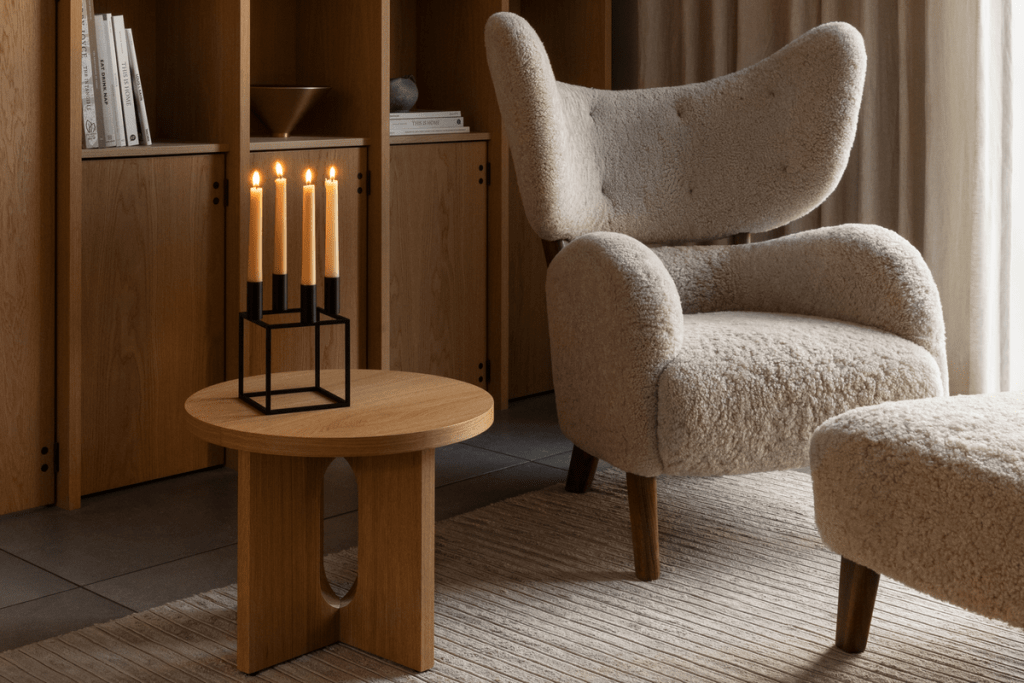
Scandinavian design has achieved sustained global popularity, with concepts like hygge and Scandi entering the design lexicon and shaping how we think about interiors. With clean lines, functional forms, and an emphasis on comfort, this design style remains universally appealing.
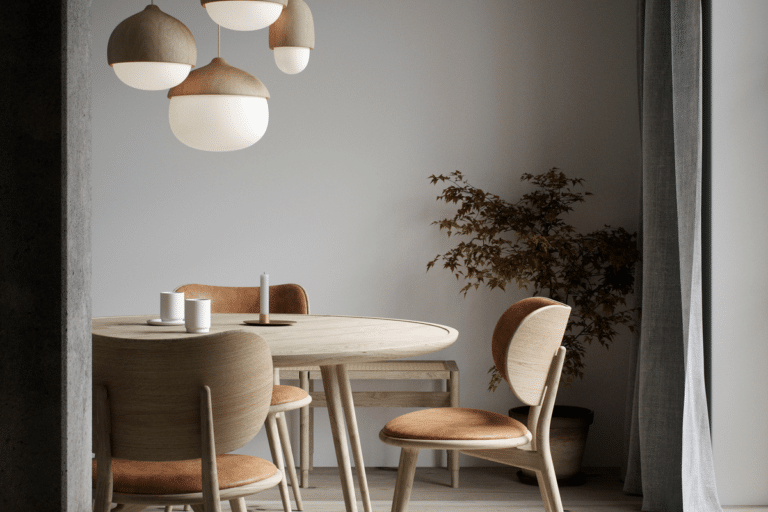
The Nordic nations of Sweden, Finland, Norway, and especially Denmark are renowned for their modern living room furniture and interiors. Clean-lined and functional, yet taking on evocative shapes drawn from nature, Scandinavian design initially helped bring modernism to the masses by making it more humanistic. The quality and craftsmanship of pieces from the likes of Arne Jacobsen, Alvar Aalto, and Verner Panton continue to resonate. In fact, such classic design tenets inform a wide array of new furniture and lighting designs.
In this guide, we explore the origins and evolution of Scandinavian style, its defining characteristics—from palette to materials to light—and how to bring the look home, room by room.
What Is Scandinavian Design?
If there was a starting point for Scandinavian design as it is recognized today, it was in the 1950s after World War II, when social democracy was at its height in the Nordic countries of Denmark, Iceland, Norway, Finland, and Sweden.
The Beginnings

In the early 20th century, the Industrial Revolution and Germany’s Bauhaus school inspired European designers to create furnishings free of ornamentation, yielding streamlined, machine-inspired functionalism. Scandinavian designers put their own spin on the style, incorporating elements of their longstanding craftsmanship traditions, particularly light-colored woods.
A defining moment came at the 1930 Stockholm Exhibition, which introduced Scandinavian Functionalism to an international audience. Later, the 1954 Brooklyn Museum “Design in Scandinavia” traveling exhibition brought Nordic design to American audiences, while the Lunning Prize (1951–1970) celebrated the region’s leading designers and cemented Scandinavia’s place on the world stage.
Finland’s Alvar Aalto, celebrated architect and modern furniture designer, helped pioneer the use of bending plywood in the mid-1930s. Many of his bentwood pieces are still in production today, such as the Stool 60, which has been in continuous production for 90 years.
The 1940s and ’50s
During and after World War II, a new generation of Scandinavian designers enjoyed increasing influence and explored modern furniture designs that combined new materials and familiar natural forms. Finnish-born architect and industrial designer Eero Saarinen made his name in the United States while a student at the Cranbrook Academy of Art in Michigan. He co-designed a bent plywood chair with Charles Eames that won the Museum of Modern Art’s “Organic Design in Home Furnishings” competition in 1940.

Saarinen would go on to design modern furniture classics like the Womb Chair in 1948 and the Tulip Chair in 1957, as well as architectural landmarks like the St. Louis Arch and the Trans World Airlines terminal at New York’s John F. Kennedy International Airport.

It was also around this time that Denmark took the lead in Scandinavian design. Thanks to the success of numerous Danish designers like Arne Jacobsen and Hans Wegner, the phrase “Danish Modern” became shorthand for Scandinavian design (and middle-class sophistication). Like Aalto, Jacobsen was an architect and furniture designer. He not only created the elegant glass tower SAS Royal Hotel in Copenhagen but also its interior, including the AJ collection lamps.

Hans Wegner also became one of the most prolific modern furniture designers. His CH24 Wishbone Chair from 1949 represented his philosophy of “continuous purification,” with a Y or wishbone-shaped backrest that includes a curving back rail and brief armrests.

Embracing new technologies and forms, Scandinavian designers like Poul Henningsen and Verner Panton adopted a more futuristic style, favoring extravagant geometric forms and bold colors. Henningsen’s PH Artichoke lamp, designed in 1958, may look like that petal-covered vegetable but does so for a practical reason: to distribute overhead light without glare. It has since become one of the most iconic works of modern lighting design.
The 1960s and Today

While he started in the ’50s, Verner Panton really hit his stride in the non-conformist 1960s and ’70s. His look was all about improbable shapes, vibrant colors, and exploring innovative manufacturing processes. His S-shaped Panton Chair was the first chair formed from one piece of molded plastic. It was designed in 1959-60 and went into production with Vitra in 1967.
Today, the popularity of Scandinavian furniture has reached every corner of the globe. Many of the classics are still in production as well as new designs inspired by them from brands like Vitra, Artek, and Knoll. Scandinavian style has spread to home accessories as well, including decorative glass and streamlined kitchenware from brands like iittala and Audo Copenhagen.
It’s simple to see how, over the years, the appeal of Scandinavian design endures: warm modernism with a natural, human feel.
Scandinavian Design Yesterday, Today, and Tomorrow

Aalto collection by Alvar Aalto from littala
In response to elaborate, unapproachable pieces, the Scandinavian design movement was based on the belief that functional, simple, modern, and beautiful everyday objects should be well-made and accessible to all—not reserved for the few. Scandinavian designers embraced this mindset with an additional component: creating furniture that was thoughtfully designed and built to last would encourage people to purchase fewer, better-quality pieces.
This set of ideals was termed “Functionalism,” and it resulted in the creation of many furniture pieces considered classics today. Emerging at the same time as Modernism, it is easy to see the parallels between the two: both embrace clean lines, sleek frames, and harmonious balance.
There are some differences between the two: Scandinavian design plays to pale, neutral colors and light wood tones, whereas Modernism favors darker woods like walnut and colors like mossy greens and burnt oranges. The two aesthetics play well together, however, and can merge seamlessly in a modernist space.
Scandinavian, Nordic, or Mid-Century Modern?
These terms are often used interchangeably, but there are meaningful distinctions.
Scandinavian refers specifically to design originating from Denmark, Norway, and Sweden.
Nordic is the broader geographic term, encompassing Scandinavia plus Finland and Iceland. In practice, “Scandinavian design” often includes Finnish and Icelandic work, given the shared aesthetic philosophy.
Mid-Century Modern is a design movement spanning roughly 1945–1970, encompassing American, European, and Scandinavian work. Scandinavian design of this era is a subset of mid-century modern—but the two are not synonymous.
| Aspect | Scandinavian | Nordic | Mid-Century Modern |
|---|---|---|---|
| Palette | Warm whites, soft grays, muted accents | Similar, with regional variations | Bolder: mustard, teal, burnt orange |
| Materials | Light woods (ash, birch, oak), wool, linen | Same, plus reindeer hide, birch bark | Darker woods (walnut, teak), molded plastic |
| Mood | Cozy, minimal, hygge-driven | Varies by region; often nature-inspired | Optimistic, graphic, sculptural |
The Art of Hygge

Hygge is a Danish term that has become part of the design conversation. While related to Scandinavian design, hygge is not a style—it’s a feeling. It refers to a sense of contentment, coziness, and well-being, often cultivated through simple pleasures: soft lighting, warm textiles, and time spent with loved ones.
Where Scandinavian design provides the framework—clean lines, natural materials, uncluttered spaces—hygge supplies the atmosphere. The two work in concert: a well-designed Scandinavian interior creates the conditions for hygge to flourish.
A related concept is lagom, a Swedish term meaning “just the right amount.” Where hygge emphasizes coziness, lagom speaks to balance and moderation—another thread woven through Scandinavian design philosophy.
To create a hygge-inspired atmosphere:
- Layer textures such as plush knit cushions and cashmere throws.
- Choose wood finishes like natural oak or warm walnut.
- Use lighting that can be dimmed to create intimate warmth.
Bring the Look Home, Room by Room
Scandinavian design integrates seamlessly with other styles—modern, farmhouse, industrial, transitional—thanks to its clean, adaptable lines. Here’s how to apply its principles throughout your home.
Living Room
Start with low-profile seating in neutral upholstery, complemented by a wool or jute rug. Layer lighting with a mix of pendants, floor lamps, and table lamps. Keep surfaces uncluttered and let a few intentional accessories—a sculptural vase, a stack of design books—anchor the space.
Dining Room
A pale-wood dining table pairs naturally with iconic chairs like the CH24 Wishbone or sculptural modern alternatives. A statement pendant—whether a classic like the PH Artichoke or a contemporary design—becomes the room’s focal point.

Bedroom
Light oak furniture and layered natural textiles—linen bedding, a wool throw, sheepskin at the bedside—create the hygge warmth that defines Scandinavian sleeping spaces. Keep the palette soft and the surfaces clear.
Kitchen
Open shelving in natural wood, fiber or wood stools at the island, and uncluttered countertops maintain the Scandinavian ethos. Simple, well-designed kitchenware becomes part of the decor.
Entry
A pale wall, a simple bench, and a few hooks create a welcoming, functional entry. Large mirrors reflect light and make smaller spaces feel open.
Home Office
A streamlined desk in light wood, a comfortable yet sculptural chair, and a single statement lamp create a focused, calming workspace.
The Essentials
Throughout your home, keep these principles in mind:
- Paint the walls pale. White and light tones brighten interiors to make for open, airy rooms.
- Lighten up the wood. Find wood flooring and furniture pieces in bleached tones to complement lightened walls.
- Flood the space with light. Layer multiple light sources for cozy, welcoming warmth.
- Invest in quality pieces. The multifunctional nature of Scandinavian furniture favors fewer, higher-quality pieces, leaving more space open for light and air.
- Maintain minimalism. Uncluttered surfaces and a less-is-more philosophy are hallmarks of Scandinavian spaces. Storage solutions like cabinets and cupboards keep spaces clear and clean.
- Embrace coziness and candles. The easiest additions for optimal hygge are candles and blankets. Lighting a few tealights in the evening transforms the atmosphere.
Bringing It All Together
The appeal of Scandinavian design endures because it speaks to something essential: warm modernism with a natural, human feel. Its emphasis on quality craftsmanship, natural materials, and thoughtful light creates interiors that are both beautiful and livable.
Whether you’re drawn to the iconic pieces of Aalto, Jacobsen, and Wegner or the contemporary work of brands like Muuto and Audo Copenhagen, Scandinavian design offers a timeless framework for intentional living.