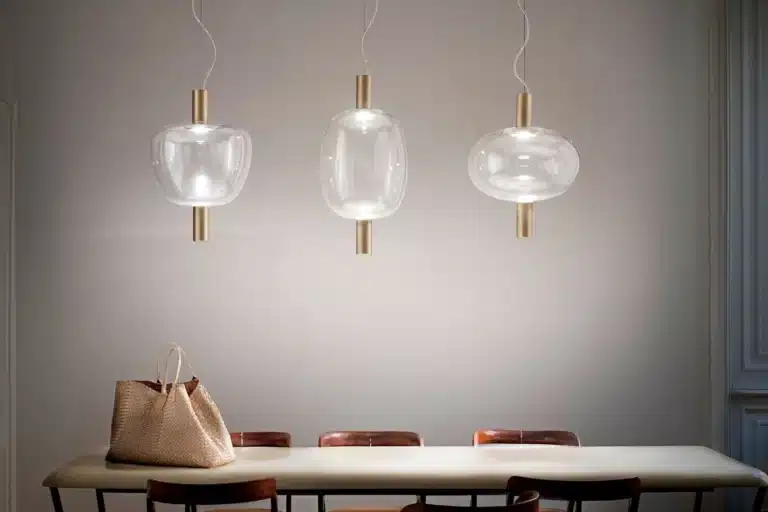
Vistosi traces its roots back to 16th-century Venetian glass making, but the lighting company is far from a relic. The brand has continued to improve and update its processes to stay cutting-edge while still honoring the craftsmanship and tradition of mouth-blown glass lighting. The result: lighting designs that are striking and well-made.
An Italian house devoted to Murano glass lighting, Vistosi pairs a heritage reaching back to the 1500s with a modern lighting company founded in Murano in 1945. We had the pleasure of learning more about Vistosi Lighting: its heritage, new initiatives and what to expect from the historically cutting-edge brand for the next few centuries to come (or at least the next year).
A Legacy in Murano Glass
Vistosi carries forward one of design’s most storied material traditions. Its roots reach back to the earliest days of Venetian glassmaking, when the craft of blown glass first took hold on the island of Murano. The modern lighting house emerged centuries later, and it has remained in the hands of a single family ever since — a rare continuity in a field defined by reinvention.
- c. 1585 — The heritage begins with 16th-century Murano blown glass.
- 1945 — Guglielmo Vistosi founds the modern lighting company in Murano.
- Moretti stewardship — Giancarlo Moretti guides the house, followed by his son Matteo Moretti, the current CEO.
- 2007 — Vistosi begins producing the metal structures of its lamps in-house.
That lineage sets the stage for the conversation that follows, in which Vistosi reflects on its heritage and its vision for what comes next.
The Interview
Vistosi has such a rich history, stretching back to the 1500s on the legendary Venetian glass-blowing island of Murano, and still plays an important role in lighting design to this day. What innovations have led to such a long-lasting company?
The company’s history has stayed true to two assumptions: It has remained a family operation and has continued the tradition of the Murano glass crafting, passing it down through generations. The secret blend of Vistosi’s glass has been always improved through the centuries. Probably the most innovative one in recent history is the unique blend developed by Vistosi for its crystal glass to make it as clear, pure and shining as “iced water.” Vistosi’s master glassblowers are always up to the challenge of manufacturing new designs from the endlessly creative international designers that collaborate with the brand. After the mouth-blowing process, our artisans rigorously take care of the process of the “finishes:” drilling, grinding and polishing are very precise and accurate. All carried out under the knowledge that any little mistake could waste the entire job.

So you still employ traditional methods for making your lighting fixtures?
Research is the core of Vistosi’s innovation. There are hundreds of years of knowledge inside the Vistosi glass factory. Just in the last 50 years of personal experience of the Moretti family, from Giancarlo to his son Matteo, the current CEO of Vistosi, they have all been involved in the glass production process: From chemical blending to fusion process, from mould manufacturing to mouth-blowing techniques, from finishing of the glass to its surface treatment, from design to industrial projecting; the full team of more than 100 people involved in the company share this special passion.
What new methods have you introduced?
Vistosi approached the challenge of the new millennium with innovation and originality, converting almost all the collections to LED. The new designs are the perfect fusion between glass art and LED technology. The focus of Vistosi has always been on innovation and the new collections are examples of Vistosi’s team skills: From design research to manual crafting, from engineering to assembling, everything is carefully supervised and made by expert personnel.
In 2007, Vistosi built our own production department to manufacture all the metal structures of its lamps as well as glass. Manufacturing 100% in-house allows us to maintain a very high standard quality of the full production process: from sand and metal to complete certified lighting fixtures.

Like ‘Medea,’ a collection of lamps where a shaded milky half-tone glass is perfectly emphasized into three different icon shapes, together with a powerful integrated LED module and assembled with any visible connection, one of the missives of Vistosi, since Vistosi considers that avoiding shadows is as important as creating a beautiful light effect.

The crafting precision required for the Plot collection to realize three pairs of holes on a large glass shade, blown to allow the passing through of metal rods that gently hold a pure sphere of white satin blown glass, lighted by a LED module like a glowing heart.

Another example is the Futura collection that in just a few years became a masterpiece of Vistosi. It consist of a single blown glass with a unique handcraft process to make it in transparent colour at the upper part and diffuser colour finish at the bottom part.
Do you have a favorite design or design process story?
Sure: Giogali collection, designed by Angelo Mangiarotti in 1967, patented by Vistosi in the same year and officially recognized by USA and the European Community, has become an emblem of the company, for the first time ever in lighting.

Vistosi has won several awards and patents for the collection. The Giogali hook has been protected with a patent since 1967. In 2010 both Giogali and Giogali 3D have been registered as a “Tridimensional Trademark” or emblem of the company by the European Community. In the same year, the U.S. Trademark Office issued the patent certificate for Giogali has a “Symbol” of Vistosi. Both registrations in Europe and USA were issued for the first time ever in lighting.

We look forward to seeing more. Considering the company is already 500 years old, any final thoughts on what we can expect from Vistosi in the next few centuries?
The Vistosi mission is to create timeless and innovative design products that provoke a unique emotion and ambiance in any space. And in any era.
How Vistosi Murano Glass Lighting Is Made
Every Vistosi fixture begins as molten glass and ends as a finished, certified object, with the entire journey overseen by the house itself. Murano glass lighting of this caliber depends on the hand of the master glassblower, whose breath shapes each form before it is refined with precision. Since 2007, Vistosi has also fabricated the metal structures of its lamps in-house, giving it control of the full production chain from glass to completed fixture.
The process moves through distinct stages:
- Mouth-blowing — Designs are shaped by master glassblowers, one piece at a time.
- Hand finishing — Each form is drilled, ground, and polished by hand with great precision.
- In-house metalwork — The metal structures have been produced within the company since 2007.
This command of every step is what allows more than 100 people at Vistosi to hold quality to a single, unbroken standard.
Vistosi’s presence continues to reach an international stage: the house showcased at Euroluce during the 63rd Salone del Mobile in Milan in April 2025 with a two-level booth designed by studio atelier oï, alongside its recent Link collection of hammered crystal rings that interlock into modular light chains.