In the nearly five decades since founding Luceplan, Paolo Rizzatto’s profundity of design and philosophy has only become magnified, a stature affirmed in 2024 with a Compasso d’Oro career award. Perhaps it’s his mid-century coming-of-age, his Polytechnic formal education, or the influence of post-war Italy’s second renaissance. His insights into design belie a deep appreciation for the nurturing influence of this rich cultural environment and the creative potential of societal and technological landscapes. For Rizzatto, lighting design is not merely about illumination but a potent tool that can reshape private and urban spaces, a silent yet transformative architectural medium. His meticulous design process, harmoniously considering myriad components, underscores the intriguing interplay of structure and serendipity in the world of creation.
In this exclusive interview, we explore his processes, touch on a few of his famous designs and learn more about his vision of how emerging technologies and environmental consciousness are reshaping the future of lighting design.
Who Is Paolo Rizzatto?
Paolo Rizzatto is an Italian lighting designer and architect born in Milan in 1941. He graduated in architecture from the Politecnico di Milano in 1965 and began his career at Arteluce, before co-founding Luceplan in 1978 with Riccardo Sarfatti and Sandra Severi.
His body of work includes some of the most enduring lamps of the era, among them Berenice, Costanza, Titania, Metropoli, and the Hope chandelier. Rizzatto has received the Compasso d’Oro five times for individual designs, in 1981, 1989, 1995, 2008, and 2011, and was honored with a Compasso d’Oro career award in 2024. Explore his complete collection of designs by Paolo Rizzatto at Lumens.
What does "Made in Italy" mean to you?
The great Italian designers (I am speaking of the progenitors: Albini, Gardella, Zanuso, Sarfatti) were trained in a high-level “humanistic cultural environment” and grew up immersed, even in the physical sense, in an environment very rich in formal and artistic solicitations all scales (from the object to the house and the territory) and therefore have been able to deepen and enrich the limited technological and functional world of rationalism. To all this is added the existence of territorial areas formed by a very dense fabric of small companies but rich in culture and technology with great flexibility and a very high disposition for experimentation.
It is this fortunate coincidence fueled by the post-war reconstruction fervor that gave birth to that phenomenon which only later will be exploited by often mediocre and provincially heirs called “Italian Design” (why in English?).
The future does not need flags or borders but only a great need for design intelligence.

What is your design philosophy?
The term “Design” is simply the English translation of the beautiful Italian word progetto. From a strictly etymological point of view, progettare means “to throw beyond:” a propensity to see what is beyond the obstacle…to know.
The project for me is nothing more than a continuous cognitive process which, enriched by the memory of the past, expert of the current reality and prescient of the future from form and translates “now” into a physical (but also conceptual) object what before was only in the state of need, of desire or (if we want) of “theme.”

What makes for good lighting—is there more to it than simply illuminating a space?
Light (theater teaches us this) can completely distort the perception of space and, if used correctly, it is a fantastic tool for modifying the private and urban scene. Light creates reliefs, makes colors visible, modifies them and constitutes a real architectural material like concrete, glass, wood and steel with the difference that it is immaterial, silent, impalpable and, in itself, invisible. From this point of view, the lighting project is in a certain sense facilitated compared to other design areas in developing an attitude that is respectful of the context, non-invasive and in full harmony with the land that hosts us.
Today we would say Ecocompatible.

What is your design process? Does it start in the studio, or does inspiration strike you in unexpected ways?
My interest in the art world, my training and practice as an architect mean that I continually use the concept of “composition:” the design of a building as well as the design of an object is above all a “compositional fact.” I always try to take into account all the components involved without making one prevail over the other. Many and various components come into play: historical, typological, functional, usage, formal, technical, industrial, economic, commercial, communicative, ecological. It is therefore necessarily a very structured process…. However, uncertainty, chance, the unexpected have always been inherent in all design processes…. And I would even say that they contribute decisively to the fascination of all creative processes.
And then how do you take something from an idea to a design to an actual object?
There is an indissoluble bond between the project and the reality of which it is a part.
For me the idea is not an a priori— it does not arise from intuition or even from imitation but from the knowledge of the thing being designed and from its definition. The project is knowledge of reality and definition of a transformation hypothesis.
I could say that every good project is a “utopia of reality,” and I would add that I don’t want to give up either term, neither utopia nor reality.

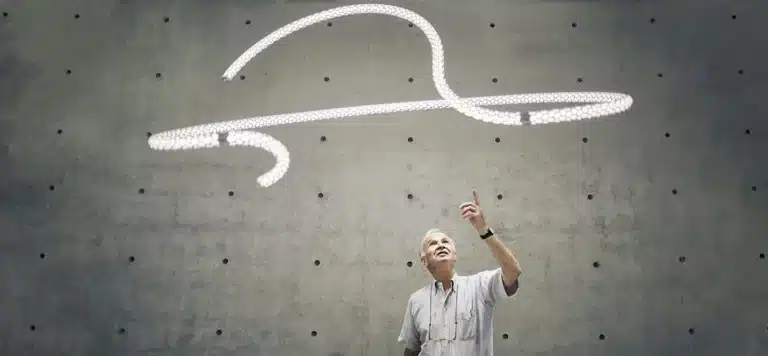
Can you share the design process/story behind the Squiggle LED Chandelier for Rotaliana?
As a child I had seen, hovering over the staircase of the Palazzo dell’Arte in Milan, an impressive luminous arabesque of gigantic dimensions. I was struck by it. It was the “Neon Structure for the IX Triennale di Milano” created by Lucio Fontana with curved neon tubes. That freely monumental image, neither painting nor sculpture, has accompanied my entire life as a designer and from time to time it reappeared in my mind.
Here, today, that LED technology allows us to create a continuous line of light free in space; the project quite simply consisted of giving a shape and dimensions to this line, in order to make it a product, easily realizable, movable, economical, saleable, in a word: usable.

Can you share the story behind one of your best-known designs, the Hope Chandelier for Luceplan?
Hope’s story is so long that it had to be made into a book. I can only say that more than 40 years have passed between the intention of making a “chandelier” and its creation with relative placing on the market.
It is a large artifact that gives light to an environment, which has a value both for the light it emits and for its formal quality; for its physical presence.
A decorative value, a lighting value but also a vocation to generate wonder.
How do you design alongside changes in the industry as far as new technologies, techniques, sustainability needs and other developments?
Designing a lamp above all means designing light and its relationship with man and architecture: what matters is not the product but the quality of light that the lamp emits.
The new LED technologies and the ever-increasing awareness of the limited resources of the planet we live on are in fact a mix that can give an exponential boost to the development of light design.
Frequently Asked Questions
Who is Paolo Rizzatto?
Paolo Rizzatto is a Milanese architect and lighting designer, born in 1941 and trained at the Politecnico di Milano. He co-founded Luceplan in 1978 and is celebrated for designs including Costanza, Berenice, Titania, and Metropoli.
When was Luceplan founded, and by whom?
Luceplan was founded in 1978 by Paolo Rizzatto, Riccardo Sarfatti, and Sandra Severi. The Milan-based company became one of the defining names in modern Italian lighting.
Who designed the Costanza lamp, and when?
Paolo Rizzatto designed Costanza for Luceplan in 1986. In 2026 the lamp reaches its 40th anniversary, a testament to the quiet longevity of its design.
Who designed the Luceplan Hope chandelier?
The Hope chandelier was designed by Paolo Rizzatto and Francisco Gomez Paz in 2009. It went on to receive the Compasso d’Oro in 2011.
How many Compasso d’Oro awards has Paolo Rizzatto won?
Rizzatto has won five Compasso d’Oro product awards, in 1981, 1989, 1995, 2008, and 2011. In 2024 he received a Compasso d’Oro career award, alongside a further product award for the Figaroqua Figarolà lamp.
Is Paolo Rizzatto still working?
Yes. He remains active, with recent collections for Nuura and Rotaliana by LUMINART, and, in 2024, the Figaroqua Figarolà lamp designed with Mario Nanni for Viabizzuno.