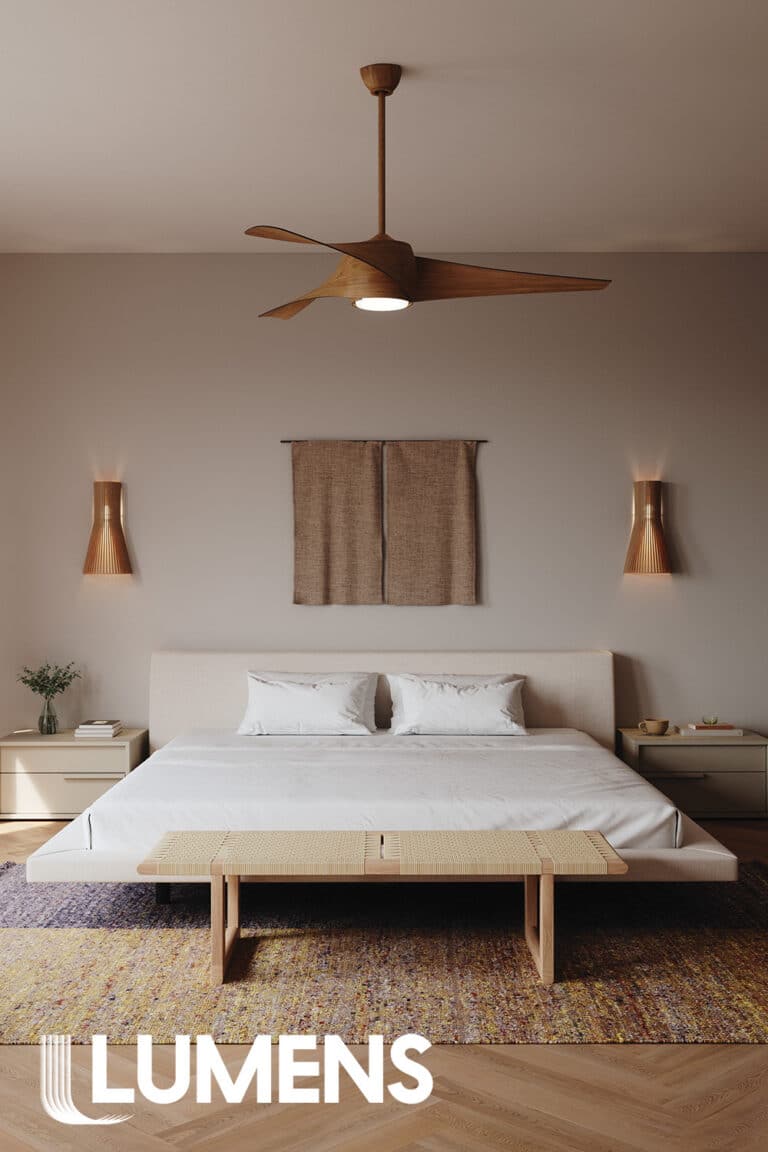
Looking for the ideal ceiling fan? With so many sizes, styles, and features to consider, selecting the right one can feel like a design project in itself. This expert guide from Lumens breaks down everything you need to know so you can choose a ceiling fan that delivers comfort, efficiency, and style in any room.
Key Takeaways
- Precision sizing guidance for every room, from compact offices to open great rooms
- Mounting options for standard, low, high, and sloped ceilings
- Indoor, outdoor, and coastal fan ratings explained
- Style direction across modern, mid-century, transitional, industrial, and minimalist designs
- Smart home integration with Matter, Thread, and voice assistant compatibility
- DC motor and ENERGY STAR efficiency for quieter, lower-energy performance

The Art of the Ceiling Fan
A well-chosen ceiling fan is one of the most effective design upgrades you can make to a room. It draws the eye upward, introduces movement and rhythm to a static ceiling plane, and creates an architectural focal point that no recessed fixture or table lamp can replicate. As energy efficiency becomes an increasingly important consideration and smart home ecosystems continue to mature, ceiling fans have evolved far beyond their utilitarian origins. Today’s models integrate seamlessly with voice assistants, offer whisper-quiet DC motors, and come in designs worthy of a gallery wall. Whether you are furnishing a new build or refreshing a living room, a ceiling fan is a design decision that pays dividends in comfort and character.
Ceiling Fan Size Guide: Find the Right Fit for Your Room

Zephyr 5 Indoor/Outdoor LED Smart Ceiling Fan by Modern Forms
The first step in choosing a ceiling fan is matching the fan size to your room. An undersized fan cannot circulate air effectively, and an oversized one can overwhelm a space both visually and functionally.
Ceiling fans are measured by their blade span (also called blade sweep): the diameter of the circle traced by the blades in motion, measured from the tip of one blade to the tip of the blade directly across. Before shopping, measure your room’s length and width and calculate the square footage.
With the dimensions of your room in hand, use the size guide below to find the optimal ceiling fan:
| Fan Size | Room Size | Room Type |
|---|---|---|
| 29″ or less | Less than 50 sq. ft. | Hallway, Laundry Room, Walk-In Closet |
| 36″ | Up to 75 sq. ft. | Breakfast Nook, Large Bathroom |
| 42″ | Up to 100 sq. ft. | Bedroom, Office, Kitchen |
| 52″ | Up to 225 sq. ft. | Master Bedroom, Dining Room, Patio Area |
| 56″ | Up to 400 sq. ft. | Large Living Room, Great Room |
What Size Ceiling Fan for Common Room Dimensions?

Room dimensions often matter more than abstract square footage. Here are specific recommendations for popular room sizes:
- 10×10 room (100 sq. ft.): A 42-inch fan is the ideal fit. A 52-inch model will feel oversized in this space and may push too much air for comfort.
- 12×12 room (144 sq. ft.): A 52-inch fan is the right choice, providing strong airflow without dominating the room visually.
- 14×14 room (196 sq. ft.): A 52-inch fan works well here. For rooms approaching 200 square feet with higher ceilings, a 56-inch fan offers additional coverage.
When in doubt between two sizes, choose the larger fan and run it at a lower speed. A larger fan moving slowly is quieter and more efficient than a smaller fan working at full speed.

Ceiling Fan Mounting Height and Installation
For maximum performance and safety, your ceiling fan should hang at least 7 feet from the floor (per building codes), with 8 to 9 feet being ideal for optimal air circulation. Here is how to choose the right mounting option:
- Low Ceilings (8 feet or less): Use flushmount or “hugger” ceiling fans for a sleek, low-profile look without sacrificing headroom.
- Standard and High Ceilings (9 feet and above): Select a fan with a downrod. Increase downrod length by 6 inches for every foot above 9 feet of ceiling height.
- Sloped Ceilings: Most ceiling fan canopies accommodate slopes up to 30 degrees. For steeper angles, use sloped-ceiling adapters.
Fans typically come with one or two downrods in standard lengths. If more length is needed to achieve the ideal hanging height, additional downrods in other sizes can be purchased. For a room with a 9-foot ceiling, select a fan with a 6-inch downrod. For ceilings higher than 9 feet, add 6 inches to the downrod for every foot of height: 10-foot ceiling, 12-inch downrod; 11-foot ceiling, 18-inch downrod; and so on.

Install with Confidence: Ceiling Fan Junction Boxes
Ceiling fans must be mounted to junction boxes rated “For Use With Ceiling Fans.” These boxes are designed to support the fan’s weight and vibration over time, and they should be anchored directly to a ceiling joist or supported by a brace bar spanning two joists. Standard light fixture boxes are not rated for the dynamic load of a spinning fan and should never be used as substitutes.
When to Call a Professional
If you are replacing an existing ceiling fan, the installation is typically straightforward as long as the junction box is already fan-rated and the wiring is compatible. However, if you are installing a fan where only a light fixture existed, or where there is no existing electrical box, consider hiring a licensed electrician. A professional can verify the box rating, confirm the circuit can support a fan and light kit combination, and ensure the wiring meets local code. This is especially important for older homes where wiring may not meet current standards.
Indoor and Outdoor Ceiling Fans

Choosing the right ceiling fan also means considering where it will live. Not all fans are built for every environment, and selecting the correct rating ensures long-term performance and safety.
- Dry-Rated (Indoor Only): Standard ceiling fans are designed for climate-controlled interiors. They are ideal for bedrooms, living rooms, offices, and any fully enclosed space.
- Damp-Rated: Damp-rated ceiling fans are built to withstand moisture and humidity. Use them in bathrooms, covered patios, screened porches, and other spaces where the fan will not be directly exposed to water but may encounter humid conditions.
- Wet-Rated: Wet-rated ceiling fans can handle direct contact with rain and water. Choose these for open porches, gazebos, pergolas, and any outdoor space without a protective roof overhead.
For coastal homes and waterfront properties, look for fans with marine-grade finishes and corrosion-resistant hardware. Salt air accelerates wear on standard metals and finishes, so investing in a fan engineered for these conditions protects both performance and appearance over time.
When in doubt, choose the higher rating. A damp-rated fan works perfectly indoors, and a wet-rated fan handles any covered outdoor space with ease. Upgrading the rating adds durability without compromising design.
DC Motor vs. AC Motor Ceiling Fans
DC motor fans represent the next generation of ceiling fan engineering:
- Up to 70% more energy efficient than standard AC fans
- Virtually silent operation
- Lightweight, compact design
- Multiple speed options (often up to 6)
- Faster start-up and longer lifespan
DC motor fans reward the discerning buyer with near-silent operation, precise speed control, and engineering built for longevity.
Ceiling Fan FAQs

What Size Ceiling Fan Do I Need for a 12×12 Room?
A 12×12 room is 144 square feet, which falls comfortably in the range for a 52-inch ceiling fan. This size provides strong, even airflow without overwhelming the space visually.
Expert Tip: If the room has standard 8-foot ceilings, pair that 52-inch fan with a flushmount or low-profile design to maintain adequate headroom.
Is a 52-Inch Fan Too Big for a 10×10 Room?
Yes. A 10×10 room is 100 square feet, and a 42-inch fan is the best fit. A 52-inch fan in this space would sit too close to the walls, reducing airflow efficiency and creating a visually cramped appearance.
Expert Tip: Measure your room carefully before ordering. A 42-inch fan in a compact room delivers better airflow and a more proportional look than an oversized alternative.
How High Should a Ceiling Fan Hang from the Floor?
Building codes require a minimum of 7 feet from the floor to the bottom of the fan blades. For optimal air circulation, 8 to 9 feet is ideal. Use downrods to achieve the right height in rooms with ceilings above 9 feet.
Expert Tip: Add 6 inches of downrod length for every additional foot of ceiling height above 9 feet.
What Is the Most Energy-Efficient Ceiling Fan Motor?
DC (direct current) motors are the most energy-efficient option, using up to 70% less electricity than traditional AC motors. They also run quieter and offer more speed settings for fine-tuned comfort.
Expert Tip: Look for fans that combine a DC motor with ENERGY STAR certification and an LED light kit for the highest overall efficiency.
Can I Use an Indoor Ceiling Fan on a Covered Porch?
Not safely, no. A covered porch requires at minimum a damp-rated ceiling fan, which is built to handle humidity and moisture exposure. If the fan could be exposed to rain or direct water, choose a wet-rated model instead. Standard indoor fans are not built to withstand these conditions and may corrode, malfunction, or pose a safety risk.
Expert Tip: For any outdoor installation, check both the fan’s UL rating and the junction box rating to confirm both are suitable for the environment.
How Many Blades Is Best for a Ceiling Fan?
Blade count is a design choice, not a performance factor. Modern motor technology ensures that a three-blade fan can move just as much air as a five-blade model. Three blades offer a streamlined, contemporary silhouette, while five blades create a more traditional look. Focus on the fan’s CFM rating for actual airflow performance.
Expert Tip: If noise is a concern, fewer blades at lower speeds tend to produce less turbulence. Pair a three-blade design with a DC motor for the quietest operation.
Find Your Perfect Ceiling Fan
The right ceiling fan does more than move air. It shapes how a room feels, how it looks, and how efficiently it runs throughout the year. Whether you are drawn to a sculptural three-blade design or a classic five-blade silhouette, the best choice is one that fits your space, matches your style, and delivers the airflow and efficiency your home deserves. Explore the full Lumens collection to find the fan that belongs in your room.